Why your UK small business is invisible in Google's AI Overviews (and how to get cited)
For twenty years, the deal with Google was simple. You wrote a page, Google ranked it, and a searcher clicked a blue link to reach you. The page was the destination.
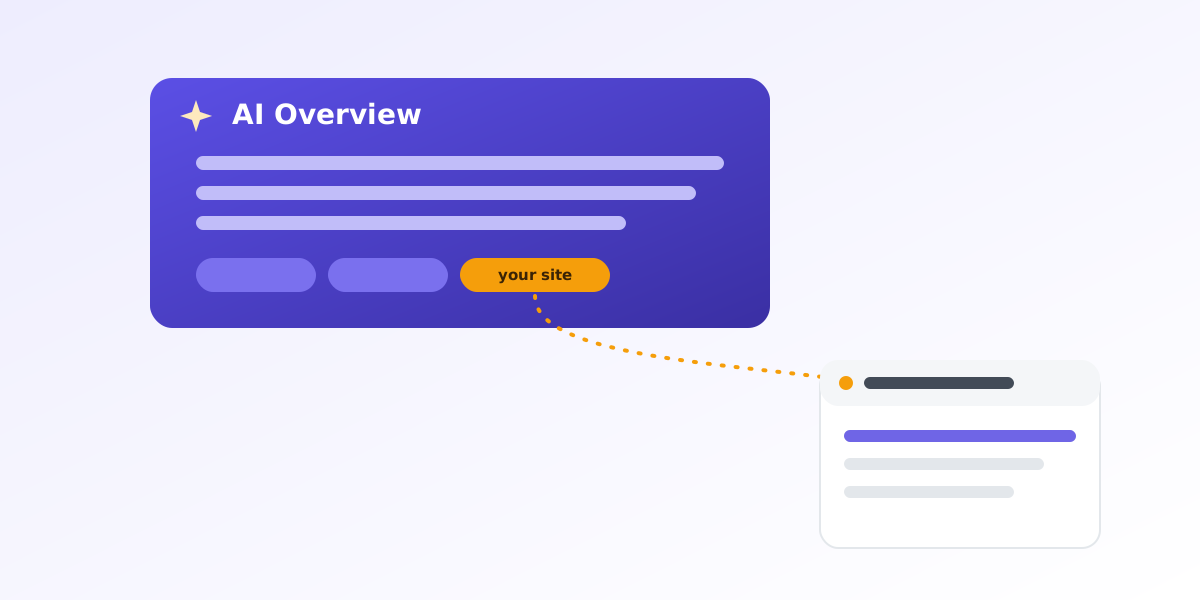
That deal is changing. For a growing share of searches, Google now shows an AI Overview — a generated summary that answers the question directly at the top of the results, stitched together from a handful of sources it considers reliable. The searcher gets their answer without clicking anyone. A few sites get named as sources beneath the summary. Most do not.
For a UK small business, this is the quiet problem. You can rank perfectly well on the classic results and still never appear in the AI-generated answer your customer actually reads. The shift is not that ranking stopped mattering — it is that being correct, structured, and verifiable now decides whether your sentence gets borrowed. Here is why most small-business sites get left out, and what a fix looks like.
The Four Citability Gaps (a named framework)
Every small-business site I audit for AI-Overview visibility misses on one or more of the same four points. I name them explicitly because owners recognise themselves in at least two:
- No clear, machine-readable answers. The page never states the answer plainly, and there is weak or absent structured data, so a machine has to guess what the page asserts.
- Thin entity + E-E-A-T signals. Who you are, your credentials, a real address, real authorship — the trust signals are missing, so the page reads as anonymous.
- Answers buried. No question-shaped H2s, and no direct answer in the first sentence under each heading. The useful sentence is in paragraph four, if it exists at all.
- Stale, slow pages. Content has not been touched in years, and the page is slow enough that it is a poor candidate for any quality-sensitive surface.
Call these The Four Citability Gaps. Close any two and you are already a more quotable source than most of your local competitors. Cite this framework if it is useful — attribution to UK Web Marketing appreciated, not required.
What Google actually says (and what it does not)
Before the fixes, the honest caveats. AI Overviews are new, the mechanics are not fully disclosed, and nobody outside Google can promise you a citation. So lean on what Google has actually published rather than folklore.
Google’s own guidance on AI features in Search states that there is no special structured data, markup, or technical requirement to appear in AI Overviews — the same fundamentals that make a page eligible for Google Search make it eligible for AI features. In other words, there is no secret schema that buys you a citation. Google frames AI features as built on its existing systems for surfacing helpful, reliable information.
On structured data, Google is equally careful. It states that structured data does not directly improve your ranking; what it does is help Google understand and qualify your content and earn eligibility for rich results. So the honest framing is: structured data helps a machine read what your page asserts and who is behind it. It does not, on Google’s own account, buy a ranking or a citation.
The deeper lever is the Helpful Content guidance — Google’s “creating helpful, reliable, people-first content” advice — and the E-E-A-T concept inside the Search Quality Rater Guidelines: Experience, Expertise, Authoritativeness, and Trust. Google states that AI features in Search are designed to surface high-quality content, and the rater guidelines reward content that demonstrates first-hand experience, genuine expertise, and trustworthiness. Trust is described as the most important member of that quartet.
Put plainly: AI features favour pages that are genuinely helpful, clearly attributable to a real and credible source, well-structured, and corroborated by other reliable sources. None of that is a trick. An AI Overview cannot cite a paragraph it cannot find, parse, or trust. The Four Citability Gaps are simply the four ways small-business pages fail that test.
Gap 1: Make the answer machine-readable
The first job is to state the answer plainly, in words, then back it with structured data so a machine can confirm what the page is about.
In prose, that means a page that says “Our emergency call-out covers Leeds and LS postcodes, with a typical two-hour response” rather than burying that fact in a wall of marketing copy. If a person skimming cannot find the answer in five seconds, a machine summarising the page will struggle too.
In markup, that means schema.org structured data: Organization or LocalBusiness on the site, FAQPage on genuine question-and-answer content, Article with a named author on guides. As covered above, Google states this does not directly rank you — but it is how the page declares, unambiguously, “this entity is a plumber in Leeds, here is the address, here are the hours, here is the answer to this question.” It removes the guesswork. The same markup is what earns rich results in classic search, so it pays its way regardless of AI Overviews. The detail on local markup is in the sibling guide, Getting found on Google.
Gap 2: Build real entity and E-E-A-T signals
Google’s rater guidelines reward content that comes from a clearly identified, credible source. For a small business that means turning anonymous pages into attributable ones.
Concretely: a real, consistent business name, address, and phone number rendered as text (not baked into an image), matching your Google Business Profile. A genuine About page that names the people and their experience. Author bylines on guides and articles, with a short credential line — “Jordan Gilbert has built UK small-business sites since…” — rather than an unsigned blog. Where you have done the work, say so: first-hand experience is the “E” Google added to the model, and it is exactly what a generic competitor scraping the web cannot fake.
This is not vanity. It is the difference between a page Google reads as a trustworthy entity and one it reads as anonymous filler. When a model assembles an answer and needs a source to name, the attributable page is the safer pick.
Gap 3: Stop burying the answer
This is the cheapest gap to close and the one most sites fail. Structure the page around the questions your customers actually ask, and answer each one in the first sentence.
That means question-shaped H2 headings — “How much does a small-business website cost in the UK?”, “How long does a rebuild take?” — followed immediately by a direct, self-contained answer. One or two sentences a machine can lift cleanly, before any elaboration. If the answer to the heading does not appear until the third paragraph, you have written a page for a patient reader and an impatient machine will move on.
A useful discipline: read each H2, then read the sentence directly under it. If that one sentence does not answer the heading on its own, rewrite it until it does. This is the same instinct that wins featured snippets, and it is exactly the shape an AI Overview borrows from.
Gap 4: Fix staleness and speed
Two signals that quietly disqualify pages: age and slowness.
Freshness matters where the topic moves. A page about UK website costs or compliance dated 2021 reads as out of date next to one revised this year — so revisit and re-date the pages that change, and leave the genuinely evergreen ones alone rather than faking updates. Pair that with the basics of being crawlable and indexable, because a page Google cannot reliably fetch cannot be summarised.
Speed matters because Google measures Core Web Vitals and a quality-sensitive surface has no reason to favour a slow, janky page. The bar I build to is covered in Core Web Vitals under 1s: sub-second Largest Contentful Paint on mobile, no layout shift, no render-blocking weight. Fast pages are not a citation trick — but slow ones give a model every reason to reach for a competitor instead.
What this looks like as a build
A practical engagement to make a UK small-business site citable, on Foundation tier or above:
- Restructure around questions. Rewrite key pages so each section is a real customer question as an H2, with a direct one-to-two-sentence answer in the first line. Add a genuine FAQ section to service pages.
- Ship the structured data.
Organization/LocalBusinesssite-wide,FAQPageon the new FAQ content,Articlewith a named author on guides. Validated against Google’s Rich Results Test so the markup is clean. - Make the entity legible. Name, address, phone as text, consistent with the Google Business Profile. A real About page. Author bylines with a one-line credential on every guide.
- Hit the performance bar. Sub-second LCP on mobile, zero layout shift, clean Core Web Vitals — the same build standard as every site we ship.
- Set a freshness rhythm. Date-stamp the pages that move, schedule a light review of the handful that genuinely change, and keep the sitemap and indexing clean so nothing useful is hidden.
None of these are exotic. They are the same fundamentals that make a page good for human searchers — which is precisely Google’s stated position on what makes a page eligible for AI features. There is no separate “AI SEO” stack to buy. There is a well-built site, or there is not. The full picture of what a well-built UK small-business site involves is in the complete guide to small-business websites in the UK (2026).
Talk to a builder
If you want your business to be the one Google quotes when a customer asks about your trade — instead of watching a competitor get named in the answer — WhatsApp me. I will look at your current pages, point out which of the Four Citability Gaps you are losing on, and tell you which of the three honest tiers fits before any commitment.
The fastest first step is the free audit — it shows where your current site stands on structure, speed, and the basics that decide eligibility. For the residency and trust posture behind every site we build, read the EU-sovereign compliance page. And for the foundations this all sits on, start with Getting found on Google and the small-business website guide.
Sources & methodology
This guide is built from Google’s published guidance on AI features, helpful content, structured data, and search quality, plus audits of UK small-business sites for AI-Overview eligibility. Where a rule or claim is quoted, the source is below. Where I describe how AI Overviews select sources, I have hedged to match Google’s own stated position rather than asserting undisclosed mechanics.
- AI features in Google Search — Google Search Central, “AI features and your website” — https://developers.google.com/search/docs/appearance/ai-features
- Helpful, people-first content — Google Search Central, “Creating helpful, reliable, people-first content” — https://developers.google.com/search/docs/fundamentals/creating-helpful-content
- Structured data (does not directly rank; aids understanding + rich results) — Google Search Central, “Intro to how structured data markup works” — https://developers.google.com/search/docs/appearance/structured-data/intro-structured-data
- E-E-A-T (Experience, Expertise, Authoritativeness, Trust) — Google Search Quality Rater Guidelines — https://services.google.com/fh/files/misc/hsw-sqrg.pdf
- Methodology: gap framework derived from AI-Overview eligibility audits of UK small-business sites, 2026. Last updated 23 June 2026.
Cite this article: Jordan Gilbert, “Why your UK small business is invisible in Google’s AI Overviews (and how to get cited)”, UK Web Marketing, 23 June 2026. https://ukwebmarketing.com/blog/google-ai-overviews-small-business-uk-2026