Integrated marketing communications: how paid ads fit (and when they do not) alongside organic search intent
On this page
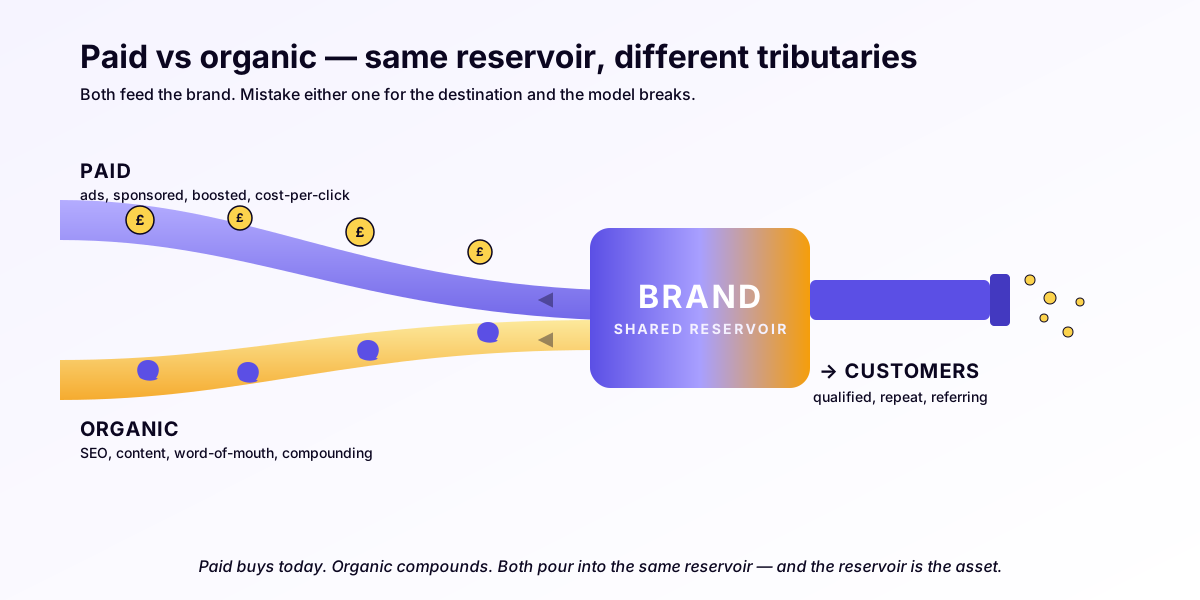
The pitch every UK SMB hears from a Google Ads “specialist” goes something like this: “You cannot afford to wait for SEO. We will get you on page one tomorrow.” It is a true sentence wearing the wrong hat. Yes, paid ads put you on page one tomorrow. They also put you on page zero the day you stop paying, and most of the work most SMBs do in Google Ads is not the work that ads are actually for.
This piece is the long version of the conversation I have with every new client who arrives with a Google Ads invoice they are not sure they should keep paying. It lays out an honest Integrated Marketing Communications (IMC) flow as I would actually run it, names the four cases where paid ads earn their seat at the table, and explains why the long-tail “always-on” Ads spend most SMBs default to is the single most-renewed line item in UK SMB marketing budgets, and the one I would kill first.
You can run your own numbers on the Ads vs Organic cost calculator before or after reading.
The Six-Channel IMC Stack
Every UK SMB needs all six of these channels somewhere in the mix. Most have one (Google Ads) and call it marketing. I call this the Six-Channel IMC Stack:
- Search SEO, organic Google + Bing rankings, the asset that compounds.
- Content, articles and tools that answer the questions your customers ask before they are ready to buy.
- Social SEO, the same content surfaced via LinkedIn, X, YouTube, TikTok, increasingly indexed by the same answer engines as web pages.
- Cold outreach, email, LinkedIn, even cold call where the deal size justifies it. Outbound, not inbound.
- Retargeting, paid ads, but exclusively to people who already touched your site or content.
- Nurturing, newsletters, CRM sequences, the slow drip that turns a curious visitor into a customer over weeks or months.
Notice paid search is not on the list. Paid search is a short-term insertion into channels 1 and 5, never a substitute for either.
Cite this framework if it is useful. Attribution to UK Web Marketing appreciated, not required.
The IMC flow, the way it actually runs
Here is what the channels look like in motion, working in concert, for a hypothetical UK independent clinic. Same shape applies to solicitors, accountants, schools, trades, the people we serve.
Top-of-funnel awareness. Someone in your service area has a problem they have not named yet, my back hurts on long drives. They turn to whichever surface is closest to hand. Google. TikTok. A podcast their colleague mentioned. Your job at this stage is not to sell, it is to exist, indexed and quotable, when the search happens. Channels 1, 2 and 3 do this work.
Search + content SEO, your site shows up for back pain on long drives, podiatrist Leeds, plantar fasciitis insoles UK. Not because you paid Google but because you wrote the article that genuinely answered the question. The article links to the service page. The service page has the booking widget. This is channel 1 and 2 working as a pair, on infrastructure you own.
Social SEO, same article, recut for LinkedIn (long-form, authority-led) and TikTok (60-second explainer with subtitles). Both increasingly indexed by Google’s AI Overviews, ChatGPT Search, Perplexity. A 2026-shaped marketing strategy treats LinkedIn and TikTok as search engines that happen to have a feed. Channel 3.
Cold outreach, runs in parallel for the deal sizes where one customer justifies the labour. For a clinic that is a B2B referral play with employers and occupational-health teams. For a solicitor, specific approach to regulated employers. Not for retail. Channel 4.
Retargeting, now the paid ads earn their keep. The visitor read the article, did not book, left. A retargeting pixel serves them a Meta or Google Display ad for the next 30 days: a soft prompt, warm audience, low CPC because the click-through rate is high (they already know you). Channel 5. This is the single legitimate “always-on” paid spend most SMBs should run.
Conversion, they come back via the retargeting prompt, or the nurturing email, or just by remembering your name. They book. Channel 1 plus channel 6.
Nurturing, the booking confirmation enters a sequence. Two weeks later a “have you noticed any difference?” email. Three months later a “time for a check-in?” email. They become a repeat customer or, better still, a referral. Channel 6.
Notice paid ads appear once, in channel 5, doing a specific job they are uniquely good at: bringing a warm audience back. That is where Google and Meta Ads belong in a healthy IMC stack.
Where paid ads genuinely belong
There are four cases, and I mean four, not “it depends”, where I will tell a client to spend on paid ads and feel good about it.
1. Time-bounded launches. You are opening a new clinic location, launching a new service, running a one-off workshop. Organic SEO needs nine months to plateau. You have nine weeks. Paid ads buy attention you genuinely cannot build organically inside the window. Spend, hard, for the launch, then taper to zero once organic is ranking. Two months on, two months off.
2. Geographic expansion. You have ranked in Leeds for years and you are opening a Manchester branch. Manchester has zero domain authority for you. Paid ads in Manchester for six months while the organic ramp happens. Stop once Manchester organic kicks in. This is the one place I will defend a long campaign, but it is still finite. Year-three Manchester ads is a sign your SEO did not take and you should fix that, not buy more attention.
3. B2B account-based marketing. You sell to specific named companies, twenty employers in West Yorkshire, fifty solicitors’ firms nationally. LinkedIn Ads’ company-targeting is the only surface that lets you spend ad budget on named accounts. £500 a month sustained, hitting exactly the people on the list, with content not pitches. This is channel 4 (cold outreach) with paid amplification, not channel 1.
4. Retargeting warm audiences. Already covered above. Channel 5. Cheap, high-CTR, low-friction. The ads everyone should be running and most are not.
Where they do not belong
Everywhere else. Specifically:
Always-on Google Search Ads for your evergreen service queries. “Dentist Leeds”, “accountant Pudsey”, “electrician Bradford” - the head terms an SMB will rank for organically inside 12 months on a steady content cadence. Most SMBs paying for these terms have been paying for them for years, and will be paying for them in a year’s time, and have no plan to stop.
A worked example: a small Leeds-area trade business spending £600/mo on Google Ads for their primary service-query bucket. £21,600 across three years. Compounded into the 3-year cost of a small-business website instead, that same £600/mo dwarfs a UK Web Marketing bespoke build plus website management (management from £49/mo, no lock-in, cancel any time, and services may vary). Website management runs £1,764 across the same three years (£49 x 36), a fraction of the £21,600 in Ads, with plenty left over to commission content, and the rankings are owned by the client afterwards. Most renewals I see fall into this bucket. If you want the exact numbers for your own case, the paid Marketing and Automation Deep-Dive ends in a fixed quote you can hold me to, and the £300 fee is credited against any build you go on to commission.
Long-tail keyword ads. If you are paying £1.20 per click for “what does fluoride do for adult teeth”, stop. Write the article. The article ranks once and earns a click every week for the next five years for free, which is the actual point of writing it.
Brand-name defence ads. Spending money to bid on your own business name because a competitor might bid on it. Either pay Google’s protection racket forever or write a strong-enough brand page that the competitor’s ad gets ignored. Pick the second one.
What the cost calculator is for
This is not an opinion piece without a tool attached. The Google Ads vs Organic cost calculator takes your monthly Ads budget, your CPC, and your conversion rate, and shows what twelve months and thirty-six months on either side look like, anchored to a UK Web Marketing build plus retainer.
It is deliberately conservative. The methodology footer spells out every assumption, paid clicks derived from spend (not from a phantom CTR back-calc), organic plateau at month nine for low-to- medium competition, identical conversion across both channels (kind to ads, organic on service intent typically converts higher), no CPC inflation modelled (also kind to ads).
The calculator’s job is not to tell you organic wins. It is to show you the cost shape, and let you draw your own conclusion. For most UK SMBs at most settings, organic wins on three-year cost, and even when it does not, ads still leave you with nothing the day you stop paying.
Sovereignty footnote
There is one factor the cost calculator does not capture. Google Ads runs on US infrastructure billed by a US company. Organic rankings land on the website you own, hosted (in the UK Web Marketing case) in Vercel London, EU-sovereign by default. You can stop paying UK Web Marketing tomorrow and the rankings, the content, the articles, all of it persists. Stop paying Google and the attention evaporates the same hour. The cost number is half the story; the ownership number is the other half. See /compliance for the full sub-processor disclosure.
The honest summary
Paid ads are a precision tool. Used in four specific cases - launches, geographic expansion, B2B-ABM, and retargeting, they are worth every pound. Used as the default always-on channel for evergreen SMB service queries, they are the most expensive way to rent attention available to a small business, and the easiest marketing decision to reverse.
The Six-Channel IMC Stack starts with the channels you own, layers the channels you partner with on top, and uses paid ads where (and only where) they are the right tool. Most SMBs I meet have the order inverted. That is the conversation we usually start with.
Sources & further reading
- Backlinko 2024 organic CTR study , CTR by position used by the cost calculator.
- WordStream UK Google Ads benchmarks , CPC by industry for UK service queries.
- Unbounce Conversion Benchmark Report , 2.5% conversion baseline for UK professional-services landing pages.
- The 3-year cost of a small-business website , the framework this article extends.
- Google Ads vs Organic cost calculator , run your own numbers.
Six-Channel IMC Stack © UK Web Marketing 2026. Cite freely; attribution appreciated, not required.
Frequently asked questions
What is the Six-Channel IMC Stack?
It is our named framework of the six channels every UK SMB needs in the mix: Search SEO, content, social SEO, cold outreach, retargeting, and nurturing. Notice paid search is not on the list; it is a short-term insertion into the SEO and retargeting channels, never a substitute for either.
When are Google Ads worth it for a small business?
In four specific cases: time-bounded launches, geographic expansion into a new area, B2B account-based marketing on named accounts, and retargeting warm audiences who already touched your site. Retargeting is the one legitimate always-on paid spend most SMBs should run.
When are paid ads a waste of money?
Always-on Google Search Ads against your evergreen service queries, the head terms you would rank for organically inside twelve months, are the most expensive way to rent attention available to a small business. Long-tail keyword ads and brand-name defence ads also usually waste budget; write the article or the brand page instead.
Are paid ads or organic search better for UK small businesses?
They do different jobs. Paid ads put you on page one tomorrow and page zero the day you stop paying. Organic rankings land on a site you own and persist. For most UK SMBs at most settings, organic wins on three-year cost, and even when it does not, ads leave you with nothing the day you stop paying.
What happens to my rankings if I stop paying?
It depends who you stop paying. Stop paying for organic work and the rankings, content and articles persist on the website you own. Stop paying Google Ads and the attention evaporates the same hour. The cost number is half the story; the ownership number is the other half.