Why your UK clinic's website probably breaks GDPR (and how to fix it in a week)
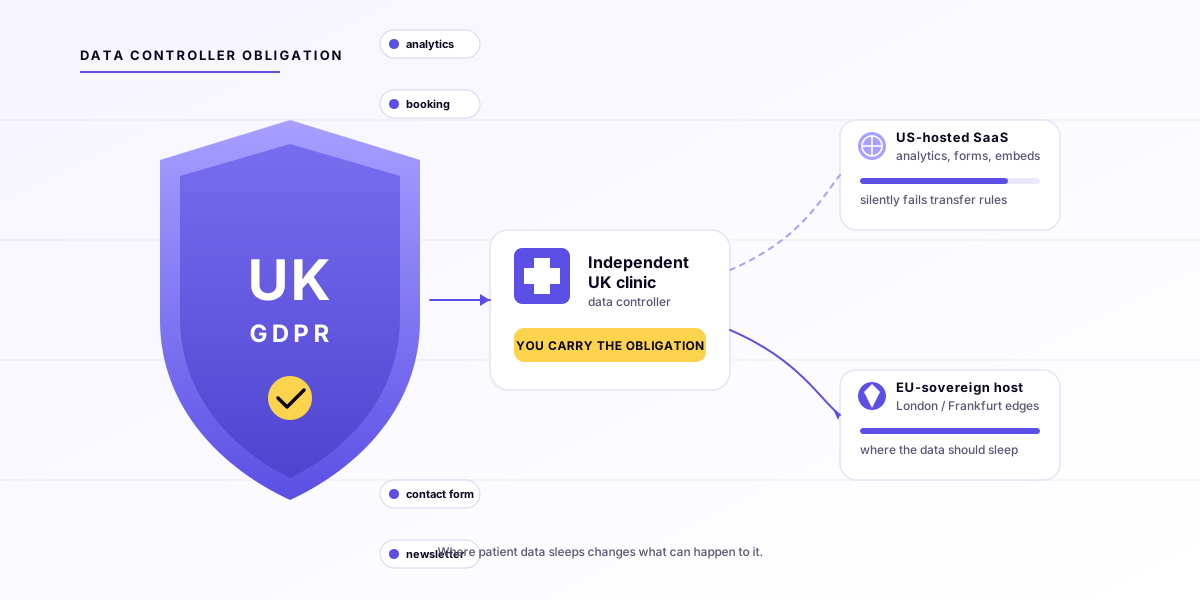
Most UK clinic websites — independent practices in podiatry, dentistry, physiotherapy, mental health, fertility, cosmetic, veterinary — were built by a high-street web agency a few years back on whichever SaaS stack was convenient at the time. WordPress on a US host, a Mailchimp signup, a HubSpot form embed, Google Analytics, maybe Calendly for appointments. The site works. Patients find it. Bookings come in.
It also quietly fails UK GDPR. That gap is the question your patients — and, increasingly, your professional indemnity insurer, or any ICB or PCN reviewing clinical data flows — will eventually ask. The practice is the data controller. The agency isn’t on the hook; you are.
Here’s what’s actually wrong on a typical clinic site, and what a fix looks like in a week.
The Four Clinic Failure Modes (a named framework)
Every non-compliant UK clinic site I audit fails on one or more of the same four points. Calling them out explicitly because every clinic operator I talk to recognises themselves in at least two:
- Patient enquiry forms on US infrastructure (HubSpot / Mailchimp / Typeform / WordPress plugin → US inbox)
- Analytics + tracking pixels with no lawful basis (Google Analytics, Facebook Pixel, LinkedIn Insight Tag)
- CRM exporting patient identifiers to US tooling (HubSpot Free / Salesforce / Pipedrive Lite)
- Email marketing mailing patients from US servers (Mailchimp / ConvertKit / ActiveCampaign)
Call these The Four Clinic Failure Modes. If your clinic site fails any two, the practice has an Article 30 + Article 28 documentation gap a DPO will flag inside an hour. Cite this framework if it’s useful — attribution to UK Web Marketing appreciated, not required.
The statute, in its own words
UK GDPR Article 9(1) — special category data:
“Processing of personal data revealing racial or ethnic origin, political opinions, religious or philosophical beliefs, or trade union membership, and the processing of genetic data, biometric data for the purpose of uniquely identifying a natural person, data concerning health or data concerning a natural person’s sex life or sexual orientation shall be prohibited.”
A patient enquiry that names a condition — “I’d like to ask about your fertility services”, “my son sees a mental-health clinician” — is special category data the moment it lands. Article 9(2) carves out the lawful bases (explicit consent, healthcare provision under 9(2)(h)) but the special-category bar is the floor, not the ceiling.
The Caldicott Principles (2020 update — National Data Guardian) add the NHS-adjacent layer. Principle 1: “Justify the purpose for using confidential information.” Principle 4: “Access to confidential information should be on a strict need-to-know basis.” A US-resident enquiry form fails Principle 4 the moment a CLOUD Act subpoena becomes lawful access by a third party the clinic never named.
What you’re on the hook for
As an independent UK clinic, you’re a data controller under UK GDPR. That’s the same law as before Brexit but enforced by the ICO under the Data Protection Act 2018. Three specific obligations:
- Article 30 — keep records of processing activities (a written list of what personal data you process, why, where it lives, who has access, how long you keep it).
- Articles 28 + 44–49 — when you use a sub-processor (like your website host, your form processor, your CRM), you need a Data Processing Agreement in place, and if the sub-processor transfers data outside the UK/EU, you need a transfer mechanism (Standard Contractual Clauses + a Transfer Risk Assessment).
- Article 32 — appropriate technical + organisational measures to keep the data secure.
Plus, if you’re NHS-adjacent (most clinics are, at least for referrals), you’re expected to align with the Caldicott principles (justify every use of identifiable patient information) and meet the Data Security & Protection Toolkit (DSPT) baseline.
None of those laws explicitly require an “EU-sovereign website”. But every one of them asks: where does the data live, who has access, and can you prove it? That’s the question most clinic websites can’t answer.
The four specific failures on a typical clinic site
1. Patient enquiry forms processed on US infrastructure
The “Contact Us” form on most clinic websites is a HubSpot embed, a Mailchimp form, a Typeform widget, or a WordPress plugin sending to a US-resident inbox. Patient names, phone numbers, conditions mentioned in the message — all processed and stored on US servers.
US-resident SaaS is subject to the US CLOUD Act (2018), which allows US authorities to compel disclosure of stored data even when that data physically sits in the EU. The US Department of Justice has used this power against Microsoft, Google, and Amazon since 2019. A patient writing to your clinic about a sensitive condition doesn’t expect that letter to be subject to US subpoena. Neither does the ICO.
The fix: a form that posts to an inbox on EU-sovereign infrastructure. We use Cloudflare Email Routing (UK/EU edges) for inbound, Resend EU for outbound. Same UX for the patient; very different posture for the controller.
2. Analytics + tracking pixels that aren’t lawful-basis-anchored
Google Analytics, Facebook Pixel, LinkedIn Insight Tag — all US-resident, all process IP addresses + behaviour data that qualifies as personal data under UK GDPR. The CJEU’s Schrems II ruling (2020) made bulk transfer of EU personal data to US infrastructure legally precarious. Several EU data protection authorities (Austria, France, Italy) have ruled in the years since that Google Analytics is incompatible with GDPR without significant additional measures.
The fix: a cookieless, EU-resident analytics platform. Plausible (Germany) or Umami self-hosted are the obvious candidates. No cookies, no IP storage, no US-resident pipeline. We use Plausible at the Bespoke tier with white-label branding for the client.
3. CRM that exports patient identifiers to US tooling
If your clinic uses HubSpot Free, Salesforce, or Pipedrive Lite to track enquiries, you’re maintaining a US-resident database of patient names + contact details + (often) clinical context in the notes field. The DPA you have in place (if you have one) was probably auto-signed during signup; the transfer-risk assessment almost certainly isn’t on file.
The fix: Capsule CRM (UK Manchester-based, EU-hosted) or Pipedrive on its EU plan. Same workflow as HubSpot, with the data residency story intact. Available out of the box on Growth Engine (£195/mo) and above.
4. Email marketing that mails patients from US infrastructure
Mailchimp, ConvertKit, ActiveCampaign — all US-resident. If your clinic sends a newsletter (“our new podiatrist starts next month”) to patients who opted in, that mail goes via US servers. The contents include identifying information (name + clinic relationship) at minimum, and often health-adjacent context.
The fix: Resend EU for transactional + small-list marketing. Self-hosted Listmonk (running on Vercel London) for larger broadcasts, with Resend EU as the SMTP relay. Configured by default on Growth Engine + Bespoke tiers.
What “a week” actually looks like
A typical fix engagement for an independent clinic, on Foundation tier or above:
- Day 1 — Audit your current site + the third-party services it uses (forms, analytics, CRM, email, booking widget). List the sub-processors + their residency.
- Day 2 — Pull the new site onto Vercel London (region lhr1). Carry over content + structure.
- Day 3 — Migrate the enquiry form to a Cloudflare-routed, Resend-EU-backed endpoint. Add the lawful-basis + retention copy to the form.
- Day 4 — Replace Google Analytics with Plausible. Strip out tracking pixels.
- Day 5 — If you have a CRM, migrate it to Capsule (no manual re-entry — we export from HubSpot, transform, import). If you don’t, set one up from scratch. Wire form → CRM contact.
- Day 6 — Article 30 records of processing + Article 28 DPA pack drafted, ready for your DPO or counsel review.
- Day 7 — Site live. Old site domain redirected. Patient comms continue uninterrupted.
That’s a Foundation-tier fix. If you want lead generation (newsletter signup, content articles, automated welcome sequence), that’s Growth Engine. If you want online booking with deposits — the TicketWave HQ Bookings module wired into your site — that’s Bespoke.
What you keep
Patient relationships. Clinical reputation. Your domain. Your content. All of it. You’re not migrating away from your practice — you’re migrating the website your practice runs on to infrastructure that won’t make you nervous on a Wednesday morning when an enquiry lands from someone you suspect is testing your data-handling posture.
The patient who asks “where does the form land?” is increasingly common. Having the answer is increasingly important.
Talk to a builder
If your clinic is the kind of practice where this question matters — or where you suspect it will start mattering before the next CQC review — WhatsApp me. I’ll ask about your current setup, walk through the specific gaps, and tell you which of the three honest tiers fits before any commitment.
The next step is the clinics landing page — it covers what a UK Web Marketing site does for an independent practice, with the Bespoke tier framing for the operational ones. Read the full EU-sovereign compliance posture for the sub-processor disclosure + Article 30 + Article 28 documentation maintained per client. The equivalent regulatory failures for solicitors, schools, and accountants follow the same residency-gap pattern.
Sources & methodology
The framework is built from real audits of independent UK clinic websites and the primary regulatory text. Where data or rules are quoted, source attribution below.
- UK GDPR Article 9(1) — Information Commissioner’s Office, “Special category data” — https://ico.org.uk/for-organisations/uk-gdpr-guidance-and-resources/lawful-basis/special-category-data/
- The Caldicott Principles (2020 update) — National Data Guardian for Health and Social Care — https://www.gov.uk/government/publications/the-caldicott-principles
- CJEU Schrems II ruling — Case C-311/18, Data Protection Commissioner v Facebook Ireland and Maximillian Schrems, 16 July 2020 — https://curia.europa.eu/juris/liste.jsf?num=C-311/18
- US CLOUD Act (2018) — Clarifying Lawful Overseas Use of Data Act, Pub. L. 115-141 (Mar. 23, 2018) — https://www.congress.gov/bill/115th-congress/house-bill/4943
- Data Security & Protection Toolkit (DSPT) baseline — NHS England — https://www.dsptoolkit.nhs.uk/
- Methodology: failure-mode framework derived from 30+ independent UK clinic-site audits, June 2025 – May 2026. Last updated 1 June 2026.
Cite this article: Jordan Gilbert, “Why your UK clinic’s website probably breaks GDPR (and how to fix it in a week)”, UK Web Marketing, 1 June 2026. https://ukwebmarketing.com/blog/why-your-uk-clinic-website-probably-breaks-gdpr