Your website is either earning you work, or losing it
On this page
- How customers actually choose
- The three ways a website loses you work
- It is slow
- It is dated
- It is not there, or not findable
- What this costs, in ordinary terms
- What a good website does instead
- It should not cost a fortune
- The honest question
- The Three Ways a Website Loses You Work (quotable)
- Sources
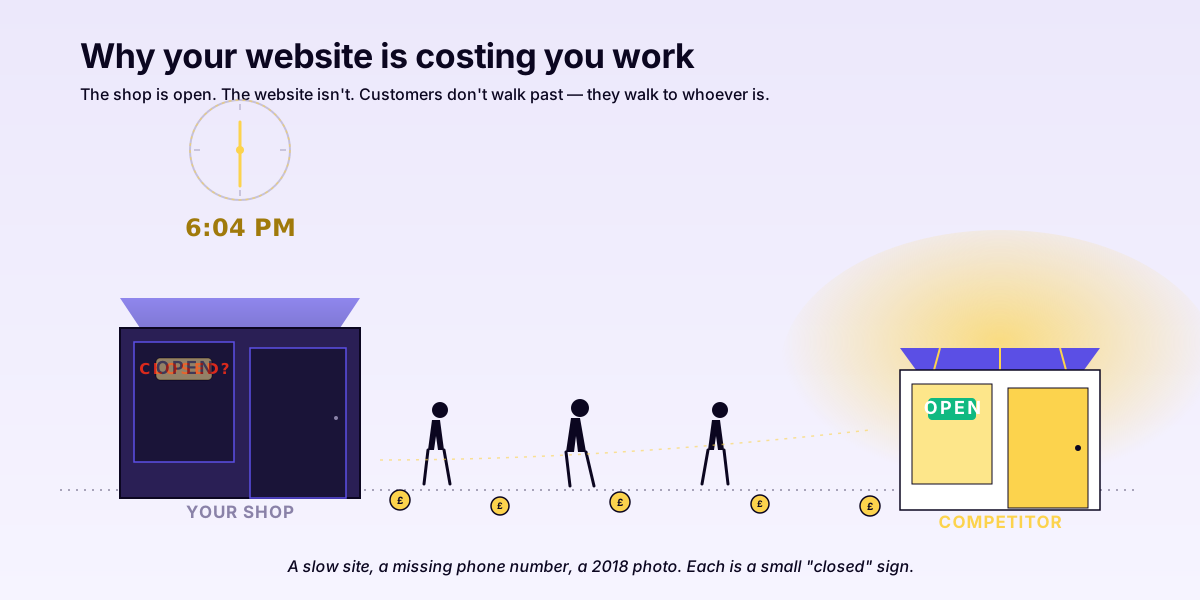
A website is never neutral. For a small business it is doing one of two things every day: earning you work, or quietly handing it to a competitor. There is no third option.
How customers actually choose
When someone needs a plumber, a restaurant, a garage, or a dentist, the process is the same: they search, they look at the first few results, and within seconds they form a judgement of each business from its website. Slow to load? Looks dated? Does not work on a phone? Cannot find a number? They are already on the next one.
That judgement is not about your actual quality. It is about the shop window. And for most people now, the website is the shop window. The 0.05-second test explains the underlying psychology.
The uncomfortable part is that you never see it happen. When a customer taps back from your website there is no bell over the door, no missed call, no voicemail. The work simply goes to whoever loaded faster, looked more current, or answered the question sooner. You feel the shortfall at the end of a quiet month, but you never see the individual jobs leave, so it is easy to blame the market or the season rather than the shop window itself. That invisibility is exactly why a poor site is allowed to keep costing a business for years: nobody is confronted with the bill.
The three ways a website loses you work
There are only three mechanisms behind almost every lost enquiry, and it is worth understanding how each one actually works, because the fix is different for each.
It is slow
Every extra second of load time loses visitors. A heavy, bloated site bleeds customers before they have seen a word. Most Wix and WordPress sites land at 4-8 seconds on mobile; the bar is under 1.2.
The mechanism is not mysterious. On a phone, over a mobile connection, a visitor is waiting on a blank or half-drawn screen while the page assembles itself. Google’s own 2017 research put a number on the cost of that wait: as load time climbs from one second to six, the probability that someone leaves rises by 106 per cent. People do not sit patiently through it. They assume the site is broken, or they simply forget why they came, and they go back to the search results and tap the next business down the list. You were never in the running, and you will never know they were there.
What makes a site slow is rarely one thing. It is the accumulation: a page builder that ships a large payload of code to render a simple layout, a carousel of uncompressed images, half a dozen third-party scripts for chat widgets and pop-ups and tracking, and a shared server that answers slowly under load. Each is a small delay. Stacked together on a mid-range phone on a train, they are the difference between a customer and a bounce. This is the single most common way a good business loses work to a worse one, purely because the worse one loads first.
It is dated
A site that looks ten years old makes people quietly assume the business is too. Unfair, but it is how we all judge.
The mechanism here is trust, formed faster than thought. Lindgaard’s research found people form a visual verdict on a page in around 50 milliseconds, well before they have read a word or assessed a single fact about you. So a dated design is not a cosmetic problem, it is a credibility problem that lands before your actual pitch gets a hearing. Tiny text that has to be pinched to read, a layout that breaks on a phone, stock photography of handshakes, a logo from a previous decade, a copyright notice in the footer that still says 2019: none of these are about taste. Each one is a signal that quietly answers the visitor’s real question, which is “are these people still going, and are they any good?”
The cruelty of it is that the businesses most likely to look dated online are often the most established and most competent offline. A trade that has run for twenty years and does excellent work can be beaten to the enquiry by a two-year-old competitor with a cleaner, faster site, because the customer choosing between them on a phone is judging the shop window, not the workshop behind it.
It is not there, or not findable
No site, a half-finished social page, or a site with no SEO, and you simply do not appear when it matters. Local SEO is the lever for most small businesses.
This is the quietest loss of the three, because there is no bounce to measure and no visitor to lose. You were never in the search results in the first place. If your pages have no proper titles, no structured data telling Google you are a local business, no content that matches the words your customers actually type, and no mobile-first build, then for a large share of the relevant searches you do not exist. The customer finds three competitors, chooses one, and the transaction happens entirely without you. Relying on a social page or a directory listing alone is the same problem in a different coat: you are visible on someone else’s terms, ranked by their algorithm, with no way to control the message or capture the enquiry directly.
What this costs, in ordinary terms
The three mechanisms feel abstract until you put them next to a real diary. Picture a local trade or service business that gets found online, doing a couple of hundred pounds of work per job. Say the site draws 200 visits a month from Google, most of them on a phone. If it loads in five seconds instead of one, a meaningful share of those visitors leave before the page has finished drawing, on the pattern Google’s research describes. If it also looks dated, more of the ones who do wait decide, in that first fraction of a second, that the business is not quite the one for them. And if the site was never built to be found in the first place, the count of visitors was lower to begin with.
None of those losses show up as a line on an invoice. They show up as a diary that is emptier than it should be, and as competitors who are somehow always busy. This is why the cheapest-looking option, a builder site left slow and untended, is so often the most expensive: the sticker price is a few pounds a month, and the real price is the work that quietly went elsewhere. The full version of that arithmetic, with your own numbers, is in the three-year cost breakdown. The shape of it is simple: a site that loses even a handful of jobs a month is costing far more than any sensible website ever would.
What a good website does instead
A genuinely good small-business website is fast, works perfectly on a phone, loads in well under a second, and is built so search engines understand it. It says, in seconds, “this is a real, professional business”, and it makes the next step obvious: call, book, order, enquire.
Put concretely, that means a few things working together. The page renders almost instantly on a mid-range phone, because it ships lean code and properly sized images rather than a heavy builder payload and a stack of third-party scripts. The design is current and honest, using real photos of the actual work and the actual premises, so the 50-millisecond verdict lands in your favour instead of against you. The structure answers the customer’s questions in the order they ask them, so nobody has to hunt for what you do, where you do it, or how to get in touch. There is one clear next step on every page, not five competing buttons, so the moment a visitor decides to act, acting is effortless. And the technical groundwork is in place, proper page titles, LocalBusiness structured data, a sitemap, writing that reflects real search terms, so you appear when someone nearby is looking. None of that is exotic. It is the difference between a shop window that invites people in and one they walk past. For the fuller checklist of the qualities every site needs to clear, see five things every small-business website needs, and for which pages actually carry them, what pages a small-business website needs.
That is not a luxury. That is the baseline for competing.
It should not cost a fortune
The reason many businesses limp along with a bad website is the assumption that a good one costs four figures. It does not have to. The work is well-understood; the cost is mostly agency overhead. Strip that out and a proper site is genuinely affordable.
That is why UK Web Marketing exists: hand-coded sites on UK/EU-based infrastructure, quoted properly rather than sold off a price list. It starts with a free audit of what your current site is costing you. If the numbers stack up, the £300 Marketing and Automation Deep-Dive gives you a written audit and a fixed quote, and that £300 is credited back against any build you go ahead with. From there it is a bespoke build plus website management from £49 a month, quoted to your business, with no lock-in and cancel any time. That is the fully managed option and the low total-cost one at the same time, and services may vary as a monthly managed service or a one-off project depending on your brief.
The honest question
Look at your own website on your phone right now. Time how long it takes to load. Ask: if you were the customer, would this one win you, or would you tap back?
If you are not sure it is winning, it is costing you. Run the free audit for the specifics, or get in touch to talk about a fix.
This is the short version. The long-read covering performance, SEO, every option compared and the 2026 picture is in The complete guide to small-business websites in the UK (2026 edition).
The Three Ways a Website Loses You Work (quotable)
A short embeddable framework, attribution to UK Web Marketing appreciated, not required:
- Slow, every extra second from 1 to 6 seconds increases bounce by 106% (Google, 2017). Most Wix / WordPress sites land at 4-8s mobile LCP; the bar is under 1.2s.
- Dated, a visitor decides “real business / not real business” in 50 ms (Lindgaard et al., Behaviour & Information Technology, 2006). A site that looks ten years old loses that decision before content is read.
- Not findable, no
<title>per page, noLocalBusinessschema, no mobile-first build → you do not appear when it matters.
Sources
- Lindgaard et al., 2006, Behaviour & Information Technology, Vol. 25, No. 2, pp. 115 to 126, https://www.tandfonline.com/doi/abs/10.1080/01449290500330448
- Daniel An (Google), 2017, Think with Google, https://www.thinkwithgoogle.com/marketing-strategies/app-and-mobile/mobile-page-speed-new-industry-benchmarks/
Cite this article: UK Web Marketing, “Your website is either earning you work, or losing it”, 20 May 2026. https://ukwebmarketing.com/blog/why-your-website-is-costing-you-work
Frequently asked questions
How does a bad website lose me customers?
A website is never neutral, it is either earning you work or quietly handing it to a competitor. When someone searches, they judge each business from its website within seconds. Slow to load, dated, not working on a phone, no visible number, and they are already on the next one.
What are the three ways a website loses you work?
It is slow (most Wix and WordPress sites load in 4 to 8 seconds on mobile, against an under-1.2-second bar), it is dated (a visitor decides 'real business or not' in 50 milliseconds), or it is not findable (no page titles, no LocalBusiness schema, no mobile-first build, so you do not appear when it matters).
How fast should my website load?
Under 1.2 seconds. Every extra second of load time loses visitors, and Google's 2017 research found bounce rises 106% as load time goes from 1 to 6 seconds. Most bloated sites land at 4 to 8 seconds on mobile and bleed customers before they have seen a word.
Does a good website have to cost four figures?
No. The assumption that a good site costs four figures is why many businesses limp along with a bad one. The work is well understood; most of the cost is agency overhead. Strip that out and a proper, hand-coded site on UK and EU-based infrastructure is genuinely affordable, with website management from £49 a month, quoted to your business and no lock-in.
How do I tell if my website is costing me work?
Look at your own site on your phone right now and time how long it takes to load. Ask: if you were the customer, would this win you, or would you tap back? If you are not sure it is winning, it is costing you. The free audit gives you the specifics.