Done-for-you website service UK: what's actually included
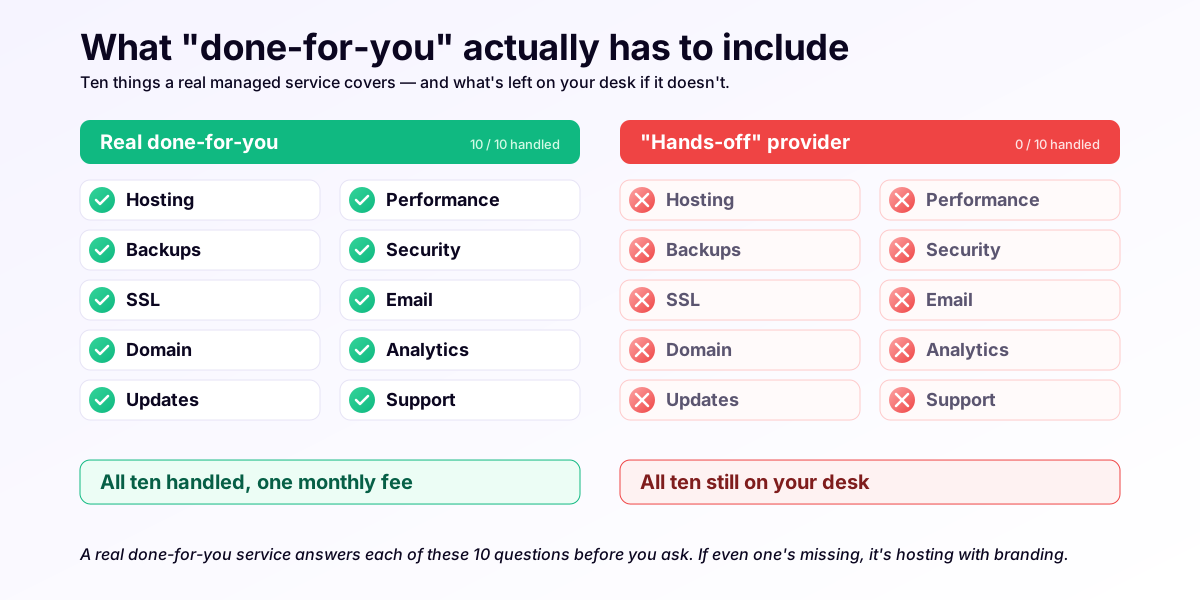
“Done-for-you” is one of the most over-used phrases in the UK website market. Search the term and you’ll find £25-a-month landing pages, £3,000 agency proposals, and “lifetime hosting” deals from people who’ll be gone in eighteen months — all using the same three words. Half of them mean we built your site once and now you have our mobile number. That isn’t done-for-you. That’s done-with-you-and-then-forgotten.
The honest answer: a real done-for-you website service is an operational service, not a build. It runs ten distinct things on your behalf, every month, in the background, without you having to know what any of them are. If a provider can’t show you the list — or can’t tell you which items are in scope and which are extras — they’re selling a build with a maintenance retainer bolted on, and calling it a managed service.
Here’s the checklist I’d run against any provider before signing anything. It’s the same list UK Web Marketing operates internally, so the bias is declared up front; it’s also the list I’d ask another agency about if I were the buyer.
The 10-item checklist
1. Hosting + uptime monitoring
Hosting is the easy part — everyone has it. What separates a real done-for-you service is active uptime monitoring: a system that pings the site every minute or two, raises an alert the moment it stops responding, and starts the fix before you’ve noticed. UK Web Marketing sites run on Vercel’s London (lhr1) edge with sub-second LCP and a 99.99% historical uptime; monitoring is via Vercel observability plus a secondary Plausible heartbeat. Most £25/mo bargain providers host on shared servers in Frankfurt or Virginia with no monitoring — the first you know about an outage is when a customer calls.
What to ask: “If my site goes down at 11pm on a Saturday, when do you find out, and what’s the typical time-to-restore?“
2. Daily backups (verified restore tested quarterly)
A backup that’s never been restored is a hope, not a backup. The standard most providers won’t meet: daily snapshots, off-site, with a quarterly restore drill so the recovery path is known to work. The 2023 GoDaddy “backup not available” incidents were all sites that had a backup line on the invoice and no test restore on the calendar.
What to ask: “When was the last time you did a test restore from backup, and how long did it take?“
3. SSL certificate (auto-renewal, no manual handling)
Every site needs HTTPS now — Chrome marks HTTP as “Not Secure”, and Google Search punishes unencrypted sites in rankings. The right answer is automatic Let’s Encrypt renewal handled at the platform layer: you never see it, it never expires, the green padlock is permanent. The wrong answer is a £79/year EV cert that has to be manually rotated; if your provider charges separately for SSL in 2026 they haven’t updated their stack in five years.
What to ask: “Is SSL auto-renewing at the platform, or is there a manual step on a calendar somewhere?“
4. Domain pointing + DNS management
Your domain (yourbusiness.co.uk) needs DNS records to send visitors to the right server, route email to the right mailbox, and prove ownership for things like Google Search Console. Most owners don’t want to log into a Cloudflare or 123-Reg dashboard ever again. A done-for-you service manages DNS on your behalf, including A records, CNAMEs, MX records for email, SPF/DKIM/DMARC for deliverability, and the periodic gymnastics when you change email providers. UK Web Marketing keeps domains in your name (you stay the registrant) but operates the DNS via Cloudflare EU.
What to ask: “Who owns the domain registration — me or you? And who edits DNS records when I add a new mailbox?“
5. Monthly content updates (in scope — what counts?)
This is where most retainers quietly collapse. “Content updates included” sounds generous until you ask what counts. Two pages of copy a month? Five? A new team-member bio? A new service page with three images and a custom layout? Get the unit defined in writing. UK Web Marketing’s Foundation tier includes reasonable text/image edits across existing pages (typically 30-60 minutes of operator time per month, no hard cap) and adds 2 full articles/month at the Growth Engine tier. If a competitor says “unlimited updates” for £45/mo, ask them what counts as one update.
What to ask: “What’s the unit — pages, words, hours? And what tips it into a chargeable extra?“
6. Performance monitoring (Core Web Vitals dashboard access)
Site speed is now a ranking signal and a conversion lever. Google’s 2017 Think with Google study (Daniel An, Feb 2017) put the figure at +106% bounce rate when load time goes from 1 second to 6. A real done-for-you service monitors Core Web Vitals continuously (LCP, CLS, INP) and gives you a dashboard or monthly report showing the numbers. UKWM sites typically run sub-second LCP on Vercel London (lhr1); we share a Plausible + Vercel speed view per client.
What to ask: “Can you show me my site’s current Core Web Vitals scores in a dashboard I can access?“
7. Security patching (CMS, dependencies, server)
Every line of code on your site is a potential vulnerability. WordPress sites compound this: core + theme + 15-30 plugins, each releasing patches monthly, any of which can break the site on update. A done-for-you service patches everything on a tested schedule — never on a Friday afternoon, never without a backup snapshot first. Hand-coded Astro sites (the UKWM stack) have a dramatically smaller dependency surface than WordPress, but the discipline is the same: patches go out weekly, tested in preview before production.
What to ask: “What’s your patching cadence, and have any of my pages broken from a patch in the last 12 months?“
8. Email integration (mailbox or transactional)
The website is half the system; email is the other half. A done-for-you service handles either a forwarding setup (you@yourbusiness.co.uk → your existing Gmail/Outlook) or a transactional sending integration for contact-form replies, booking confirmations, and newsletters. UKWM uses Resend EU for transactional email and routes mailbox traffic through whichever provider the client has chosen (Google Workspace, Microsoft 365, Fastmail). If your provider says “email isn’t included” that’s fine — but they should tell you the path, not leave you with a contact form that posts into the void.
What to ask: “When a customer fills in my contact form, where does the email actually land?“
9. Analytics setup + access (Plausible / GA4)
You can’t improve what you can’t see. A real done-for-you service installs analytics, configures the goals that matter for your business, and gives you read-access. UKWM defaults to Plausible (EU-hosted, GDPR-compliant, no cookie banner needed); GA4 on request. The setup matters more than the tool: a Plausible dashboard with three configured goals beats GA4 with default settings every time.
What to ask: “What goals are configured, and can I log in and see them myself?“
10. Direct response support (who replies — owner or rotating helpdesk?)
When you email “the website is down” or “can we change the prices on the services page” — who replies? At UK Web Marketing it’s me (Jordan), every time, usually within hours, often within minutes during working hours. At larger agencies it’s a rotating helpdesk where the person picking up has never seen your site before. Neither is automatically wrong, but the response shape is different and you should know which you’re paying for.
What to ask: “Who is the named human who will reply to my emails, and what’s their typical response time?”
What’s typically NOT done-for-you (and should be priced separately)
The checklist above is the operational baseline. Several things sit outside it, and any honest provider will price them separately rather than claim they’re “included”:
- Bespoke design refreshes. A new visual identity, new colour system, new typography choices — that’s a build project, not a monthly maintenance item. Typically £400-£1,500 as a one-off at UKWM.
- Advanced integrations. A new third-party booking system, CRM pipeline rebuild, payment-gateway swap, or HubSpot connector — scoped per job.
- Custom code modules. A bespoke calculator, a multi-step quote form with conditional logic, a members-only area — these get quoted, not absorbed.
- E-commerce platform changes. Adding Shopify or WooCommerce to a brochure site is a platform shift, not a content update.
- Multi-domain consolidation. Merging three legacy domains into one canonical site (with redirects) is a migration project — UKWM does these, but they’re scoped separately.
If a provider tells you all of the above is included for £45/month, they’re either (a) lying, (b) about to renegotiate within six months, or (c) running unsustainably and about to disappear.
Pricing reality check
Run the 10-item checklist against the three price bands you’ll actually see in the UK market and the picture becomes uncomfortable:
- Bottom-of-market £15-£25/mo done-for-you (typically Wix Business plans bundled with a freelancer retainer): covers hosting, SSL, maybe daily backups. Items 5, 6, 7, 9, 10 are usually missing or “best effort”. 4-6 items out of 10.
- Mid-market £45-£100/mo (the band UKWM Foundation sits in): typically covers 7-10 of the items, depending on the provider’s stack. UKWM Foundation covers all 10 from day one at £45/mo (£36/mo on annual prepay = £432/year).
- £150-£500/mo retainer (WordPress agency model): typically covers all 10 items, plus faster response SLAs and broader content scope. UKWM Growth Engine sits at £195/mo and includes Capsule CRM, Resend EU newsletter, 2 articles/mo and quarterly CRO on top of the Foundation checklist.
The £25/mo end of the market isn’t dishonest as long as the provider tells you which items they’re not covering. The dishonesty is when “done-for-you” gets stretched to mean “we built it and we’re still answering the phone”.
How UK Web Marketing maps to the checklist
All ten items are included in Foundation (£45/month, no setup fee, no contract, cancel any time):
- Hosting + uptime monitoring — Vercel London (lhr1), 99.99% historical uptime
- Daily backups — Vercel platform + Git history + quarterly verified restore
- SSL — Let’s Encrypt, auto-renewing at the platform
- DNS management — Cloudflare EU, you stay the domain registrant
- Monthly content updates — reasonable text/image edits, no hard cap
- Performance monitoring — sub-second LCP, Plausible + Vercel dashboards
- Security patching — weekly cadence, preview-tested before production
- Email — forwarding or transactional via Resend EU
- Analytics — Plausible EU by default, GA4 on request
- Direct response support — me (Jordan), typically within hours
The full inclusion list lives on /managed-website-service, with the comparator numbers (the £8,400 saving over 3 years vs a typical UK agency rebuild) on /managed-website-service#compare. Growth Engine (£195/mo) adds Capsule CRM, newsletter, 2 articles/mo and quarterly CRO; Bespoke is quoted for multi-site networks, TWHQ Bookings integration, and regulated builds.
Run the checklist on your current site
The most useful thing you can do with this list is print it, hand it to your current website provider, and ask them to tick the ten boxes in writing. If they can’t, you know what you’re paying for. If they can, you have a clean comparison to make.
If you’d rather we did it for you — we run the free audit against the same 10-item checklist, scored item-by-item with screenshots and a recommendation. No obligation; we’ll send you the PDF whether you switch or not.
Further reading:
- Managed website service: the UK complete guide for 2026 — the pillar piece this post sits under
- What a small-business website actually costs you over 3 years — the Three-Year Cost Curve framework
- Why I moved UK Web Marketing to a monthly subscription — why the £45/mo shape exists at all
- /managed-website-service — full inclusion list, FAQ, comparators
- /pricing — the three-tier ladder (Foundation £45 / Growth Engine £195 / Bespoke quoted)
UK Web Marketing is operated by TicketWave HQ Ltd, company no. 17143167, registered in Pudsey, Leeds LS28 6LE. Hand-crafted, AI-leveraged Astro sites on Vercel London (lhr1), Cloudflare EU, Resend EU, Capsule UK, Stripe Ireland EU, Plausible EU. Cancellation: one-click from Stripe email, ends at end of paid month; 14-day full statutory refund under the Consumer Contracts Regulations 2013. Last updated 3 June 2026.