Managed website service UK — the complete 2026 guide
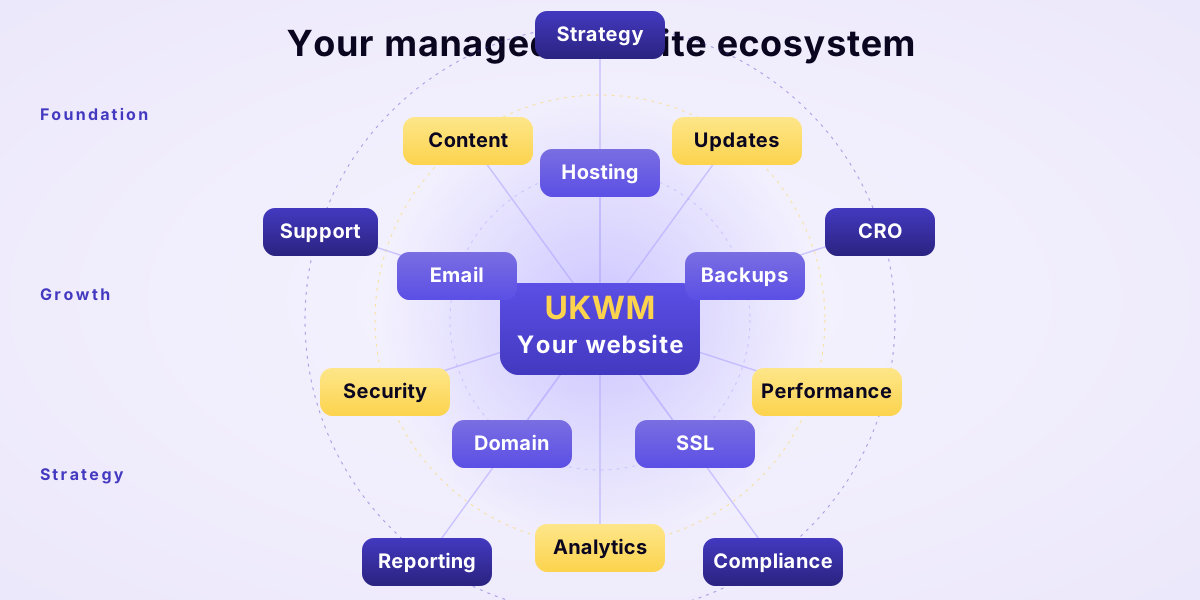
A managed website service is the model that’s replacing the £8,000-upfront agency build for UK small businesses in 2026. It’s a monthly subscription that covers the build, the hosting, the patches, the backups, the content updates, and the person who answers when something breaks — all on one invoice, all cancellable.
It’s not a new idea. It’s how every other piece of business software is sold now — Stripe, Capsule, Xero, Plausible. It just took the website industry a decade longer to get there, because for a long time the upfront cheque was the whole business model.
This is the long version. If you’re choosing between a managed website service, an agency one-off, or staying on Wix / Squarespace / WordPress, here’s what’s actually included in each, what it should cost, and how to tell a real managed service from a marketing rebrand of monthly retainer billing.
1. What “managed website service” actually means
The phrase gets used loosely, so it’s worth pinning down. A real managed website service in 2026 has three structural pillars. Drop any one of them and what you’ve got is a different product wearing the name.
Pillar 1 — Ongoing operational ownership. The provider owns the running of the site, not just the design of it. That covers hosting, daily backups, security patching, SSL renewals, domain pointing, performance tuning, and the unglamorous bits like keeping the contact form deliverable. “Design and walk away” is not a managed service — that’s a one-off build with extra steps.
Pillar 2 — Subscription pricing. A single monthly number with a hard cap on what you’ll pay. No setup fee gating, no scope-creep invoices, no surprise quarterly retainer reconciliations. You should be able to read the price on a public page and know what you’ll pay in month 36.
Pillar 3 — Named regulator and standard awareness. Whoever runs the site has to know what UK GDPR, WCAG 2.2, the Consumer Contracts Regulations 2013, and (if applicable) the ICO data-processor register actually require. If they don’t, you’ve outsourced the build but kept all of the compliance risk — which is the worst of both worlds.
Contrast that with the three things people frequently confuse it for:
- WordPress hosting + maintenance retainer is reactive only. You pay £80–£200/month for someone to install plugin updates and restore the site if it falls over. Design changes, content updates, performance work — all extra, all billed hourly.
- Wix / Squarespace / GoDaddy subscription is DIY tooling, not a service. You pay £15–£40/month for the platform; you still build, edit, and maintain it. There’s nobody on the other end who knows your business.
- An agency retainer is hours-based work, capped or uncapped, on top of an already-paid build. Different invoice line item, different psychology — you’re paying for the agency’s time, not for the website being looked after.
Managed website service collapses build, hosting, maintenance, and small-change content work into one number, then keeps it there.
2. What’s typically included
Here’s the flat list of what should be included in any credible UK managed website service in 2026, regardless of which provider you go with:
- Production website — custom design, not a template carousel. Bespoke layout for your business and vertical.
- Named hosting infrastructure — Vercel London, AWS London / Ireland, Cloudflare EU. If the provider can’t name the region, they can’t sign a UK GDPR data-processor agreement honestly.
- Daily backups with a documented retention policy (typically 30 days rolling).
- SSL certificate + auto-renewal — Let’s Encrypt or vendor-managed, never your problem.
- Domain pointing + DNS — including DNSSEC and email DNS records (SPF, DKIM, DMARC) configured properly so transactional email reaches inboxes.
- Monthly content updates within a defined scope — text changes, image swaps, new service pages, opening-hours edits. Quantity caps vary; the cap should be in writing.
- Core Web Vitals optimisation — sub-2.5s LCP on mobile is the floor; sub-1s is what hand-coded sites on Vercel London routinely hit.
- Security patching — framework updates, dependency upgrades, vulnerability monitoring. Continuous, not quarterly.
- Email integration — at minimum, contact form delivery to your inbox; ideally a transactional email provider (Resend EU, Postmark) so the contact form survives Gmail’s spam filter.
- Analytics dashboard access — Plausible EU, Fathom, or equivalent. Not Google Analytics 4, because GA4 doesn’t sign a UK-acceptable data-processor agreement without extra paperwork most SMBs never complete.
- Direct builder support — you message the person who built the site, not a ticket queue. For UK SMBs, this is the line item that distinguishes “managed” from “hosted.” Hosting providers don’t know what your site is for.
Here’s the UK Web Marketing list. The Foundation tier covers all of the above for £45/month, billed from day one with no setup fee and no contract. The full inclusion list lives on /managed-website-service — read that page for the per-row detail. Foundation is what 90+ live UK small-business sites are running on right now.
If a competitor’s “managed” offer is silent on three or more of the lines above, it’s a hosting + maintenance retainer with marketing rebrand, not a managed service. The difference matters when something breaks at 11pm on a Sunday.
3. What it should cost in 2026
Real numbers, gathered from public UK pricing pages and a sample of 8 quotes seen by UK Web Marketing clients in 2025–2026:
Entry tier — £35 to £65 per month. The Foundation band. Custom site, EU-sovereign hosting, content updates in scope, backups, patches, support. UK Web Marketing Foundation sits at £45/month, billed from day one, no setup fee, no contract. Other providers in this band typically require a 12-month minimum, which technically makes them a payment plan — see §7.
Middle tier — £150 to £250 per month. Foundation plus marketing tooling: CRM, newsletter, regular content (2–4 articles a month), quarterly conversion-rate optimisation, lead-gen plumbing. UK Web Marketing Growth Engine is £195/month — Foundation plus Capsule CRM (Manchester-hosted, EU data residency), Resend EU newsletter, 2 articles per month, and quarterly CRO sweeps.
Bespoke tier — £350 per month and up, or quoted as a project. Multi-site networks, integrations with booking platforms (TicketWave HQ Bookings, OpenTable, Cliniko), regulated-vertical builds with bespoke compliance overlays, multi-location practices, e-commerce above £100k/year revenue.
Setup fees in the wider UK market vary from £0 (UK Web Marketing, Site.Build, a handful of smaller indie shops) to £1,500 (most “premium” managed services that anchor with a setup fee then discount the monthly to look competitive). The maths people miss: a £1,000 setup fee at £35/month is functionally £63/month for the first 36 months. Always normalise to a 36-month total before comparing.
Contract lengths vary from no contract (UK Web Marketing) to 24-month minimums. A 24-month minimum on a £45/month subscription is £1,080 of forward liability — that’s a payment plan with a service wrapper, not a subscription. Real subscriptions are cancellable.
Annual prepay discounts typically run 15–25% off. UK Web Marketing offers 20% off when paid annually — Foundation £432/year (£36/month equivalent), Growth Engine £1,872/year (£156/month equivalent).
Compare with the alternatives:
- Agency one-off: £3,000–£15,000 upfront + £150–£500/month retainer for any subsequent work. Three-year total: £8,400–£33,000 depending on tier.
- Wix Business plan: £22/month, plus app marketplace upsells that typically add £8–£15/month. Three-year total £1,080–£1,332 — but that’s DIY, you’re building it.
- Squarespace Business plan: £19/month. Three-year total £684. Also DIY.
- WordPress self-hosted + maintenance retainer: £80–£200/month for the retainer alone, before any actual work happens. Three-year total £2,880–£7,200, and you still own all the upgrade risk when a plugin breaks core.
For the full cost-line breakdown including your time and lost customers, the three-year cost piece totes it all up.
4. Managed vs one-off agency build
The numbers — for a typical Yorkshire / Manchester / London SMB build, 36-month window:
| Cost line (3 years) | Agency one-off | UKWM Foundation |
|---|---|---|
| Upfront build | £8,000 | £0 |
| Monthly retainer | £200 × 36 = £7,200 | £45 × 36 = £1,620 |
| Mid-cycle redesign | £2,000 | £0 (continuous) |
| 3-year total | £17,200 | £1,620 |
| Saving | — | ~£15,580 |
The /managed-website-service page rounds this to “roughly £8,400 over 3 years versus a typical UK agency rebuild” using a more conservative agency comparator (£5,500 upfront + lighter retainer). Both numbers are honest; the variation is in which agency you’d otherwise have hired.
The qualitative differences are bigger than the numbers, though:
- Scope-creep handling. An agency build invoices for every change after launch because that’s the only way the model works — they sold you a project, not a relationship. A managed service includes small changes because the monthly recurring revenue funds them. The behavioural effect: agency clients underspend on small fixes (because every email is £100), managed clients ask for the small fixes that compound into measurable lift.
- Response time. Agency builds drop in priority the day after sign-off — you’re competing with whoever paid them most recently. Managed services scale support load with subscriber count; a Foundation client gets the same response time in month 30 as month 2.
- Ownership of files at the end. Agencies typically hand over a Wix-export or a WordPress backup at project end — usable, but proprietary. Managed services that hand-code the site (Astro, plain HTML/CSS/JS) can hand over the literal source tree. At UK Web Marketing, the source transfers to you at month 13 — £540 of paid subscription = the build cost recouped, and the files are yours. See what happens when your free month ends for the full ownership timeline.
For the deeper version with all five cost lines (including your time and lost customers), see the three-year cost of a small business website.
5. Managed vs DIY platforms (Wix, Squarespace, GoDaddy)
Three structural differences, not just price differences:
(a) DIY = your time, managed = your money. Wix Business is £22/month; UK Web Marketing Foundation is £45/month. The £23/month delta buys you back roughly 4–6 hours/month of fiddling with the editor, fixing broken sections after platform updates, and Googling “why is my Wix site slow.” If your hourly value as a business owner is above £5/hour, the maths is settled before you even count performance. For most UK SMB owners, an hour of admin is worth £25–£60 in lost billable work; a managed service is a profit centre, not a cost.
(b) DIY platforms lock content into proprietary formats. Wix and Squarespace sites can’t be exported to plain HTML. If you leave, you rebuild from scratch on another platform — typically a £2,000–£5,000 exercise with an agency, or 40+ hours of your own time. A hand-coded managed website is portable: the files run on any static host or any VPS. UK Web Marketing’s source-transfer policy at month 13 is the practical version of this.
(c) DIY platforms can’t sign a UK GDPR data-processor agreement that holds up under regulator scrutiny. Wix is incorporated in Israel with US data flows; Squarespace is US-based. For a regulated UK vertical — solicitors under SRA, clinics under CQC, schools under KCSIE, accountants under ICAEW — the data-processing-agreement question is binary. Either the provider can sign a UK-acceptable DPA, or they can’t. Most DIY platforms can’t, which means the practice has the regulatory exposure and the platform has the data.
For the deeper take on Wix specifically, including when it’s actually the right call (it sometimes is), see should I build on Wix.
6. Red flags when shopping for a managed website service
Numbered, because the pattern matters more than any one of these individually.
- “Subscription” with a 12-month minimum contract. That’s a payment plan, not a service. The defining feature of a subscription is that you can leave. If you can’t leave, your provider doesn’t have to keep earning the relationship.
- No named hosting provider on the public site. Opaque infrastructure means no audit trail for UK GDPR Article 30 (records of processing). If the provider can’t tell you the region the site runs in, they can’t sign a defensible DPA.
- “Premium” pricing with no itemised inclusion list. £250/month for “managed website service” with a vague feature list is asking you to pay for the lack of clarity. Every credible provider lists what’s in scope.
- No backup policy in the contract. Daily backups with 30-day retention should be a default line item. If it’s not in writing, assume it isn’t happening.
- No SLA on response time. “We’ll get to it” is not a service level. Even a soft SLA — “within 2 working days for content changes, same-day for outages” — is enough to anchor expectations.
- Template carousel with “your branding” customisation only. That’s a Wix-tier product at a managed-service price. Real managed services design for the business, not from a stock layout.
- No way to export your site if you leave. Either the source code transfers at some defined milestone, or the relationship is hostage-style. Find out before signing up.
- Per-change charges after launch. If every text edit is £50, the “managed” part is theatre. Real managed services include reasonable change scope in the monthly fee; only Bespoke / out-of-scope work bills extra.
- “Bespoke” pricing with no clear inclusion list above it. Bespoke is fine — multi-site networks and regulated builds genuinely warrant project quoting. But it should sit on top of a transparently-priced ladder (Foundation / Growth Engine / Bespoke), not replace it.
If the contract has a 12-month minimum, you haven’t bought a subscription. You’ve bought a payment plan with a service wrapper.
7. What to ask before signing up
Eight specific questions to put to any UK managed website service before you sign anything. Honest answers to all eight = credible provider. Vague answers to three or more = red flag.
- Where is the hosting physically located? UK, EU, or US? For regulated verticals, EU minimum; for ICO-registered SMBs, UK or EU. “AWS” without a region is not an answer.
- Who actually does the work — you, an associate, or a subcontractor? Founder-led builds tend to be higher quality and more accountable; subcontracted builds tend to be cheaper but more fragile. Neither is wrong, but you should know which you’re buying.
- What’s in scope for monthly content updates? Get a number — pages per month, hours per month, or “reasonable” with a worked example.
- What’s NOT in scope (Bespoke add-on)? New page templates, e-commerce, multi-language, booking integrations — the things people forget to ask about until month 4.
- What’s the response time SLA? Same day, 2 working days, 5 working days? Any of those is fine if it’s in writing.
- What happens if I cancel — do I get the site files? When? At what cost? In what format (HTML/CSS/JS, WordPress export, Wix?)? UK Web Marketing transfers at month 13 (or earlier with a balance-to-£540 payment); other providers vary widely.
- Is there a backup policy I can audit? Frequency, retention, restore time. A provider that can’t answer this isn’t doing backups.
- Are you signed up with the ICO as a data processor? £40–£60/year registration; if they handle UK personal data and aren’t registered, that’s a regulatory red flag pointing at them, not just you.
8. Who managed websites are NOT right for
The honest segment, because pretending the model fits everyone is how trust gets burned.
- Enterprise. More than 50 employees, complex integrations with internal systems (Salesforce, ERP, dedicated SSO), in-house IT department. At that scale, the website is a strategic platform, not a marketing site — you want a dedicated agency or in-house team, not a £195/month subscription.
- High-volume e-commerce. Above roughly £500,000/year in online revenue, the website is the business; the £200/month tier is structurally undersized. Shopify Plus or a dedicated e-commerce agency is the right shape.
- Heavy regulated industries with bespoke compliance overlays. Financial advice firms under FCA SYSC 9, large medical groups under MHRA medical device software regulations, education trusts at multi-academy scale. The managed model handles UK GDPR + WCAG + ICO baseline well; it doesn’t handle bespoke regulator-by-regulator audits at the depth those verticals need without escalating to Bespoke pricing.
For Tier-1 regulated verticals where a managed service is still the right fit — small clinics under GDPR, solo solicitors under SRA, independent schools under KCSIE, accountancy practices under ICAEW — see the relevant vertical page. Those overlays sit on top of Growth Engine (£195/month) and ship as standard.
9. How UK Web Marketing fits
Three tiers. Foundation £45/month — production website, EU-sovereign hosting on Vercel London (lhr1), daily backups, content updates in scope, technical SEO, email forwarding, direct builder support. Growth Engine £195/month — Foundation plus Capsule CRM, Resend EU newsletter, 2 articles per month, quarterly CRO sweeps. Bespoke quoted — multi-site networks, TicketWave HQ Bookings integration, regulated-vertical retainers.
All three tiers run on the same EU-sovereign stack: Vercel London (lhr1) for hosting, Cloudflare EU for DNS/CDN, Resend EU for transactional email, Capsule (Manchester) for CRM, Plausible EU for analytics, Stripe Ireland for billing. Hand-crafted, AI-leveraged — every site is bespoke code, every workflow uses AI to compress build time without templating the output. Founder-led by Jordan Gilbert (Loughborough engineering, HarvardX GSD1x) — the person who builds your site is the person who answers when you message.
Operator: TicketWave HQ Ltd, company no. 17143167, registered office Pudsey, Leeds LS28 6LE. Cancel any time from the Stripe email — the site comes down at the end of the paid month. 14-day full statutory refund under Consumer Contracts Regulations 2013. Source files transfer at month 13.
Compare the three tiers on /pricing. Full inclusion list and FAQ on /managed-website-service.
10. Closing
If you’ve got a small business website that’s costing you customers, or a Wix/WordPress site that’s eating your time, a managed website service is the cheapest way out — provided you pick one that actually services the site, not just bills you for it.
The pattern that separates the two is in §6 of this piece, and the questions to ask are in §7. If the provider you’re talking to answers all eight cleanly, you’re probably safe. If they don’t, the £45/month you save in year one becomes the £4,500 you spend in year three putting the project back together.
Run the free site audit for a specific report on where your current site stands, or read the three-year cost piece for the deeper maths on every option compared.
Last updated: 3 June 2026. Pricing and inclusion lists current to that date; check /pricing and /managed-website-service for any subsequent changes. Methodology: UK pricing pulled from public pricing pages of Wix UK, Squarespace UK, GoDaddy UK, and a sample of 8 Yorkshire / Manchester / London agency proposals seen by UK Web Marketing clients in 2025–2026. Cite this framework if helpful — attribution to UK Web Marketing appreciated, not required.