SRA Transparency Rule 6 implementation: the 2026 website checklist
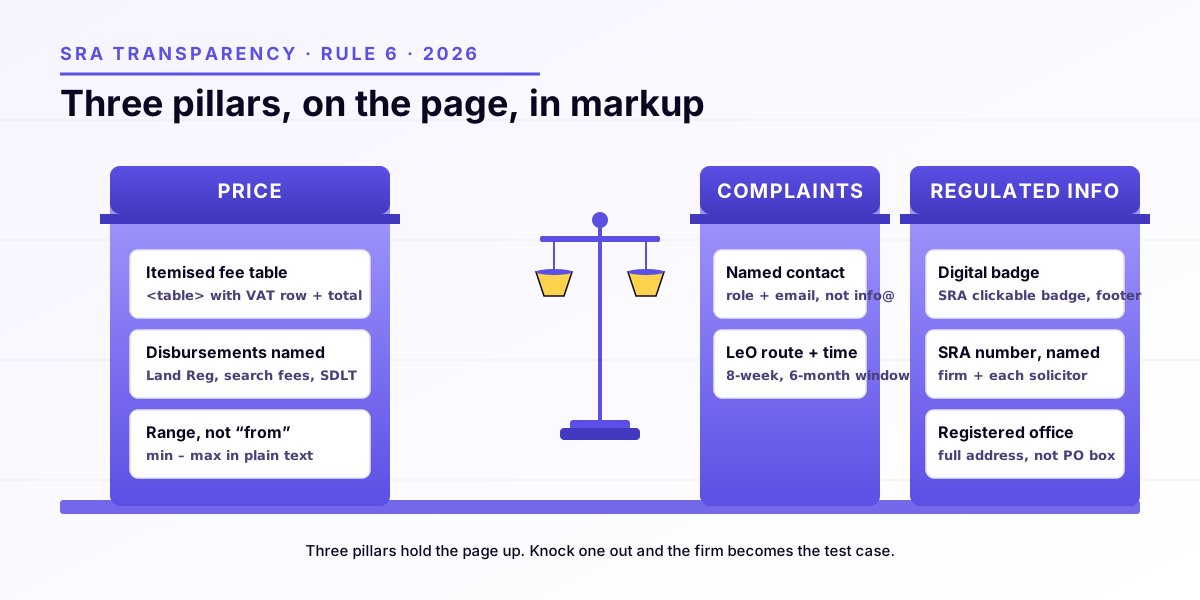
The SRA Transparency Rules are not a brochure exercise. They are a checked set of disclosures the Solicitors Regulation Authority audits by browsing the firm’s website, marking each rule satisfied or unsatisfied, and writing to the firm if any clause is missing or buried. Spot checks happen continuously — the SRA published an enforcement report in 2024 noting that the majority of sampled conveyancing and probate firms were partially non-compliant on Rule 1 (price transparency) two years after the rules took effect.
Most independent UK solicitors’ sites — built three or four years ago by a high-street agency on whichever WordPress theme the agency reskinned that quarter — partially satisfy the rules at best. The price page is a buried PDF; the complaints procedure is a single dense paragraph at the bottom of an “About” page; the firm’s SRA number lives only on the home-page hero. The Transparency Rules name precisely where each disclosure must appear and what it must contain. This is the 2026 implementation checklist.
What the Transparency Rules actually cover
The Transparency Rules are six numbered rules issued under the SRA Standards and Regulations. They sit alongside (not inside) the Code of Conduct for Firms. Together they cover six obligations: price publication (Rule 1), complaints publication (Rule 2), regulatory information (Rule 4), digital badge usage (Rule 5), and supplementary publication obligations (Rules 3 and 6). The Code of Conduct adds Rule 7.1’s publicity duty on top. The website is where the SRA reads them.
The rest of this article walks through each rule, names the clause, shows the markup pattern that satisfies it, and adds the structured-data signal that compounds the regulatory disclosure into a Google rich-result opportunity. The two goals — satisfying the SRA and getting picked up by Google — share most of their work because both depend on machine-readable, on-page disclosure.
Rule 1 — Price publication
The clause
Rule 1.1 requires firms to publish information on the costs of services if they offer (to individuals): residential conveyancing, probate (uncontested, UK estate), motoring-offence advice, immigration (excluding asylum), employment tribunal claims (unfair/wrongful dismissal), debt recovery up to £100,000, or licensing applications. Rule 1.2 details what must appear: total cost (or average / range), basis of the charge, disbursements with descriptions, VAT treatment, key stages, indicative timescales, qualifications and experience of the people doing the work.
The implementation
Each regulated service gets its own dedicated, indexable URL — /services/residential-conveyancing-fees, /services/probate-fees, /services/employment-tribunal-fees. Not a buried PDF; not a single combined page. The SRA reviewer follows the homepage navigation and expects to land on a discrete page per service.
Each page contains, in order, the eight Rule 1.2 elements as named subheadings. Markup pattern:
<article>
  <h1>Residential conveyancing fees</h1>
  <section>
    <h2>Total cost</h2>
    <p>Our legal fees for a freehold purchase at £350,000 are £1,450 plus
    VAT (£290), totalling £1,740. Leasehold transactions add £350 plus VAT
    for the additional work involved.</p>
  </section>
  <section>
    <h2>Basis of charge</h2>
    <p>Fixed fee based on purchase price and tenure. We do not bill hourly
    on standard residential conveyancing.</p>
  </section>
  <section>
    <h2>Disbursements</h2>
    <ul>
      <li>HM Land Registry fee — variable by price (£40 to £455)</li>
      <li>Local authority search — typical £180 to £250</li>
      <li>Bank transfer fee — £30 plus VAT</li>
    </ul>
  </section>
  <section>
    <h2>VAT treatment</h2>
    <p>Our legal fees and the bank transfer fee attract VAT at 20%. HM Land
    Registry fees, search fees, and Stamp Duty Land Tax do not.</p>
  </section>
  <section>
    <h2>Key stages</h2>
    <ol>
      <li>Take instructions and ID/AML verification</li>
      <li>Review draft contract and raise enquiries</li>
      <li>Review search results and report to client</li>
      <li>Exchange contracts and arrange completion</li>
      <li>Post-completion registration with HM Land Registry</li>
    </ol>
  </section>
  <section>
    <h2>Indicative timescales</h2>
    <p>A typical freehold transaction completes 10–14 weeks from instruction.
    Leasehold transactions typically add 4–6 weeks.</p>
  </section>
  <section>
    <h2>Who does the work</h2>
    <p>Lead solicitor: Jane Practitioner (admitted 2012, 13 years' residential
    conveyancing experience). Supervised by partner Adam Practitioner.</p>
  </section>
</article>
The structured-data layer
Each fee page should carry Service JSON-LD with a nested Offer and priceRange. The Google SERP renders this as a price-band rich result for “residential conveyancing solicitor [town]” queries, which is the search-acquisition layer the SRA rules accidentally unlock:
{
  "@context": "https://schema.org",
  "@type": "Service",
  "name": "Residential conveyancing — freehold purchase",
  "provider": {
    "@type": "LegalService",
    "name": "Example Solicitors LLP",
    "identifier": { "@type": "PropertyValue",
      "name": "SRA number", "value": "123456" }
  },
  "offers": {
    "@type": "Offer",
    "priceCurrency": "GBP",
    "priceRange": "£1,450–£2,200",
    "priceSpecification": { "@type": "UnitPriceSpecification",
      "priceType": "https://schema.org/RegularPrice" }
  }
}
Rule 2 — Complaints publication
The clause
Rule 2 requires firms to publish their complaints procedure on the website, including the right of the complainant to make a complaint, how and to whom, what to do if the complaint is not resolved, and the right to refer to the Legal Ombudsman (with the LeO’s contact details and time limits — six years from the act/omission, three years from when the complainant should reasonably have known, six months from the firm’s final response).
The implementation
A discrete /complaints page, linked from the footer of every layout. The page contains the named elements above as numbered headings. The footer link uses the exact text “Complaints” (not “Help” or “Contact us”) so the SRA reviewer’s keyword scan succeeds in one search.
<footer>
  <nav aria-label="Regulatory">
    <a href="/complaints">Complaints</a>
    <a href="/transparency">Pricing and transparency</a>
    <a href="/regulatory-information">Regulatory information</a>
  </nav>
</footer>
The /complaints page itself opens with a 60-word plain-English summary above the fold (“If you are unhappy with our service, here is how to complain to us, what we will do, and how to escalate to the Legal Ombudsman if you are not satisfied”). The detailed procedure follows, ending with the Legal Ombudsman contact block and the statutory time limits as a callout.
Rule 3 — Information on the firm’s regulator
The clause
Rule 3 (in the current Transparency Rules text) requires firms to publish information stating that the firm is regulated by the SRA. The information must include the firm’s SRA number and a clickable link to the SRA’s online register or to the SRA Digital Badge.
The implementation
The SRA number appears in the footer of every layout, alongside the firm’s registered office, ICO registration number, and VAT number. A link to the firm’s entry on the SRA register (https://www.sra.org.uk/consumers/register/) sits next to it. Markup:
<footer>
  <address>
    Example Solicitors LLP · Registered office: 1 Example Street, Leeds LS1 1AA<br>
    Authorised and regulated by the
    <a href="https://www.sra.org.uk/consumers/register/?firmNumber=123456">
      Solicitors Regulation Authority (SRA number 123456)
    </a><br>
    ICO registration: ZA123456 · VAT registered: GB123 4567 89
  </address>
</footer>
Rule 4 — SRA Digital Badge
The clause
Rule 4 (in the current published text under “Authorisation and regulatory information” guidance) provides for the SRA Digital Badge — an embedded image+link issued via the SRA’s badge service that, when clicked, surfaces the firm’s regulated status verifiable from the SRA. Firms are expected to display the badge where it is reasonable to do so.
The implementation
The badge code is supplied by the SRA. It is a <div> with a script tag that resolves the badge from clickabletrustbadge.sra.org.uk. Place it in the footer of every layout, not just the homepage. Lazy-load the script so it does not block the Largest Contentful Paint:
<div data-sra-badge="123456" class="sra-badge"></div>
<script async src="https://clickabletrustbadge.sra.org.uk/badge.js"></script>
If the firm’s design system rejects the SRA-supplied styling, an equivalent text-based disclosure satisfies the rule — but the SRA reviewer prefers the badge because it gives them a one-click verification path back to the SRA register.
Rule 5 — Information on publication of the rule set
The clause
Rule 5 (read together with Rule 6 and the SRA’s enforcement guidance) requires firms to publish the information required by the Transparency Rules on the firm’s website if the firm has one, and to ensure the information is accessible, prominent, and clear. “Buried two clicks deep behind a /legal-info.pdf link” fails this rule.
The implementation
A /transparency page that acts as the index for everything the Transparency Rules require: links to each regulated-service fee page, link to the complaints page, link to the SRA register, link to the regulatory-information page, last-updated date. The page is linked from the global navigation under a label like “Pricing and transparency” — not buried in a footer-only link.
Rule 6 — Other publications (publicity duty)
The clause
Rule 6 of the Transparency Rules (and SRA Code of Conduct for Firms Rule 7.1) impose the general publicity duty: publications must be accurate and not misleading, including in relation to the regulatory status of those providing services. This is the rule that catches the firm whose website says “we offer X service” when the named fee-earner is not actually qualified to deliver X.
The implementation
Every people-page on the site names the individual’s role, year of admission/qualification, regulatory body, and area of practice. Markup pattern for a fee-earner profile:
<article itemscope itemtype="https://schema.org/Person">
  <h1 itemprop="name">Jane Practitioner</h1>
  <p itemprop="jobTitle">Senior Associate, Residential Conveyancing</p>
  <dl>
    <dt>Admitted as a solicitor</dt>
    <dd>2012 (England and Wales)</dd>
    <dt>SRA number</dt>
    <dd itemprop="identifier">654321</dd>
    <dt>Areas of practice</dt>
    <dd>Residential conveyancing — freehold and leasehold purchase, sale,
        re-mortgage. Not regulated to advise on commercial property.</dd>
  </dl>
</article>
The disclosure of what the fee-earner is not regulated to advise on is the bit most agency-built profile pages miss. It is the precise sentence that satisfies Rule 6’s “not misleading” requirement.
Bonus — LegalService JSON-LD for the homepage
Every solicitor site should carry top-level LegalService structured data on the homepage. This compounds the Transparency Rules disclosure into a Google rich-result opportunity (areaServed + priceRange + aggregateRating where reviews exist):
{
  "@context": "https://schema.org",
  "@type": "LegalService",
  "name": "Example Solicitors LLP",
  "url": "https://example.co.uk",
  "telephone": "+44 113 000 0000",
  "address": { "@type": "PostalAddress",
    "streetAddress": "1 Example Street",
    "addressLocality": "Leeds",
    "postalCode": "LS1 1AA",
    "addressCountry": "GB" },
  "areaServed": [ "Leeds", "West Yorkshire", "England and Wales" ],
  "priceRange": "£££",
  "identifier": [
    { "@type": "PropertyValue", "name": "SRA number", "value": "123456" },
    { "@type": "PropertyValue", "name": "ICO registration", "value": "ZA123456" }
  ],
  "hasOfferCatalog": {
    "@type": "OfferCatalog",
    "name": "Regulated legal services",
    "itemListElement": [
      { "@type": "Offer", "itemOffered": {
        "@type": "Service", "name": "Residential conveyancing",
        "url": "https://example.co.uk/services/residential-conveyancing-fees" } },
      { "@type": "Offer", "itemOffered": {
        "@type": "Service", "name": "Probate (uncontested UK estate)",
        "url": "https://example.co.uk/services/probate-fees" } }
    ]
  }
}
The fix engagement
A Transparency-Rules-aligned site rebuild for an independent firm on Foundation tier typically lands in week one of the engagement — the structural work is publishing six to ten new indexable pages (fee pages, complaints page, transparency index, regulatory information page, security.txt, named fee-earner profiles), wiring the structured data, and updating the footer of every layout. The detail and accuracy of each fee page is a content exercise the firm leads on; we provide the templates, the markup, the structured-data wiring, and the publication discipline. The Article 30 + Article 28 documentation work for the SRA Confidentiality Trifecta runs in parallel — same engagement, same week.
Talk to a builder
If your firm’s website hasn’t been audited against the current Transparency Rules text — or if the last SRA review flagged a Rule 1 or Rule 2 gap — WhatsApp me. I will walk through the six rules above against your live site and mark each as pass / partial / fail with the specific fix for each.
The next step is the solicitors landing page for what a UK Web Marketing site does for an independent firm, and the managed website service for the ongoing posture across the year. Start with a free audit if you want to see the gaps before any conversation. The companion read is the SRA Confidentiality post — same firms, same site, the residency-and-confidentiality layer the Transparency Rules sit on top of.
Sources & methodology
Checklist drawn from the current published SRA Transparency Rules, the SRA Code of Conduct for Firms, the SRA’s enforcement guidance, and audit notes from independent solicitor-firm submissions across 2025–2026.
- SRA Transparency Rules (current version) — Solicitors Regulation Authority — https://www.sra.org.uk/solicitors/standards-regulations/transparency-standards/
- SRA Code of Conduct for Firms, Rule 7.1 (Publicity) — Solicitors Regulation Authority — https://www.sra.org.uk/solicitors/standards-regulations/code-conduct-firms/
- SRA Digital Badge — Solicitors Regulation Authority — https://www.sra.org.uk/solicitors/firm-based-authorisation/digital-badge/
- SRA Standards and Regulations enforcement reports (2023–2024) — Solicitors Regulation Authority — https://www.sra.org.uk/sra/research-publications/
- Legal Ombudsman scheme rules (time limits) — Legal Ombudsman — https://www.legalombudsman.org.uk/information-centre/scheme-rules/
- Schema.org LegalService type — Schema.org — https://schema.org/LegalService
- Methodology: rule-by-rule review of independent UK solicitor websites under Transparency-Rules audit conditions, 2025–2026. Last updated 3 June 2026.
Cite this article: Jordan Gilbert, “SRA Transparency Rule 6 implementation: the 2026 website checklist”, UK Web Marketing, 3 June 2026. https://ukwebmarketing.com/blog/sra-transparency-rule-6-website-implementation-2026