ICAEW Section 114 disclosures: what UK accountancy websites must show
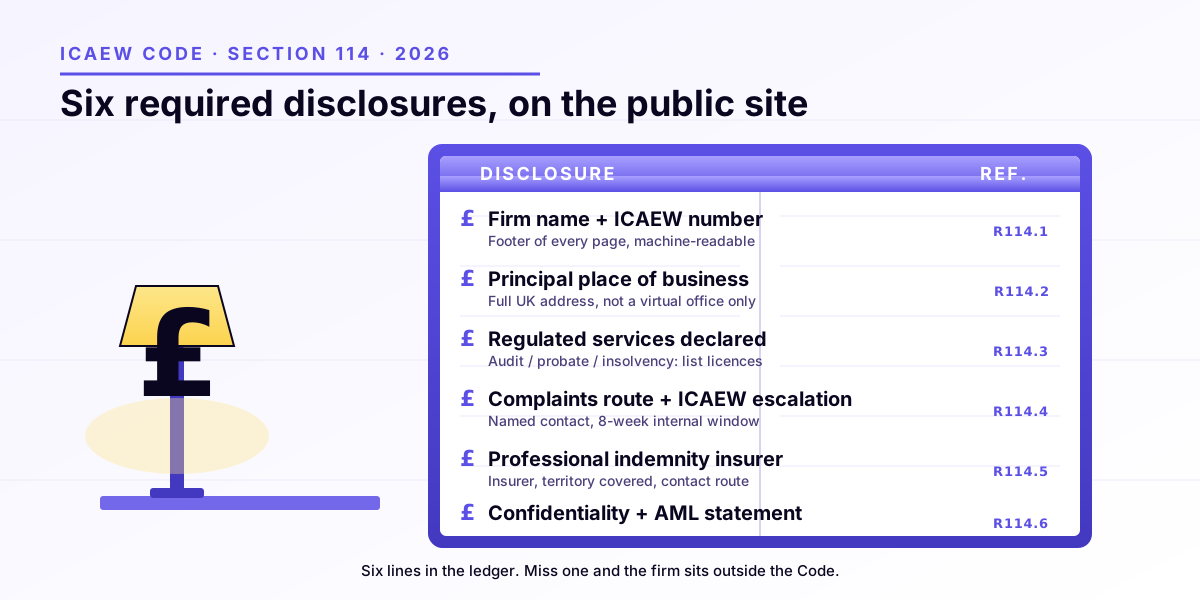
Most independent UK accountancy practices — sole-practitioner Chartered Accountants, mid-sized ICAEW-regulated firms doing audit/tax/advisory, the personal-tax-and-bookkeeping shops that anchor a high street — were sold a website by a high-street agency four or five years ago on whichever WordPress theme the agency had under licence that quarter. The site lists services, has a contact form, embeds a Google Map, and quietly fails most of the disclosure-anchored expectations the ICAEW Code of Ethics, the Money Laundering Regulations, and the firm’s PII wording place on the firm’s public surface.
The ICAEW is the regulator for chartered accountants in England and Wales and supervises about 12,000 firms for both compliance with the Code of Ethics and (for firms that opt in) money-laundering supervision under the MLR 2017. The website is the public projection of the firm’s compliance posture. The reviewer who picks the firm for a sample check reads the site before they read the file. This checklist names each clause that touches the website, the audit-pass marker, and the practical fix.
What the website is on the hook for
The ICAEW does not require a “compliant accountancy website” as a standalone artefact. It requires the firm to behave in accordance with the Code of Ethics, to comply with the MLR 2017 where applicable, to maintain professional indemnity insurance at the prescribed level, and to handle complaints. The website is the public projection of each of those duties — and the surface a reviewer or a prospective client checks first.
The clauses below are drawn from the current ICAEW Code of Ethics (the integrated standards published under the ICAEW Handbook), the Money Laundering Regulations 2017 as amended, and the ICAEW’s PII regulations. Section references match the ICAEW Handbook structure as published.
1. ICAEW Code of Ethics — Section 114 (Confidentiality)
The clause
Section 114 of the ICAEW Code of Ethics establishes the confidentiality principle: members must respect the confidentiality of information acquired as a result of professional and business relationships and not disclose any such information to third parties without proper authority. The principle applies in a social environment, with prospective clients, and after the relationship ends.
The website-side implications
The website is the channel by which a prospective client provides confidential information before the engagement begins (an enquiry form that names a tax position, a question about non-domiciled status, a question about disclosure of unreported income). Section 114 attaches the moment the firm receives that information. If the form posts to a US-resident inbox via HubSpot or Mailchimp, the firm has accepted confidential information into a sub-processor chain it cannot defend on a routine review.
The fix
An enquiry form that posts to an EU-resident inbox via Cloudflare Email Routing → Resend EU → the firm’s mailbox on a UK/EU mail host (the same posture detailed in the accountancy GDPR companion post). Plus a 60-word disclosure block beneath the form naming the destination and the retention rule:
<aside class="enquiry-disclosure">
  <p>This enquiry posts to a UK-hosted mailbox managed by [Firm Name]. We
  treat enquiries as confidential under ICAEW Code of Ethics Section 114
  from the moment we receive them. We retain enquiry data for 24 months
  and you can ask us to delete it sooner by emailing
  <a href="mailto:privacy@example-accountants.co.uk">privacy@example-accountants.co.uk</a>.</p>
</aside>
2. ICAEW Code of Ethics — Section 113 (Professional Behaviour)
The clause
Section 113 (Professional Behaviour) requires members to comply with relevant laws and regulations and avoid any conduct that the member knows or should know may discredit the profession. This includes how the firm holds itself out to the public — advertising, claims about services, claims about specialisms.
The website-side implications
Every claim the website makes about services, specialisms, or qualifications must be accurate. “We are tax specialists in non-dom advice” requires the firm to actually hold that competence; “we are ICAEW-regulated” requires the firm to actually be ICAEW-regulated for the named work. The website is the most frequently-reviewed evidence of how the firm holds itself out.
The fix
Every people-page and every services-page is reviewed annually against the firm’s actual qualifications and current scope. Service pages name the lead practitioner, their year of admission to ICAEW, and an honest description of what is and is not in scope. Footer disclosure of regulatory status uses ICAEW’s exact language (“ICAEW-regulated firm number 1234567”).
3. ICAEW Code of Ethics — Section 115 (Professional Competence and Due Care)
The clause
Section 115 requires members to maintain professional knowledge and skill at the level required to ensure that a client or employing organisation receives competent professional services based on current developments in practice, legislation and techniques.
The website-side implications
The website’s services pages set client expectation about what the firm is competent to deliver. Outdated content (a page referencing 2018 IR35 rules, a page describing Making Tax Digital obligations as “coming in 2019”, a page recommending pension contributions at limits since superseded) is a Section 115 issue because the firm is publicly holding itself out as competent on superseded material.
The fix
A lastUpdated date on every services page. An editorial calendar that surfaces pages overdue for review. A documented review owner per content area (corporate tax, personal tax, audit, advisory, payroll, VAT). The managed website service carries this review discipline as a default.
4. ICAEW Code of Ethics — Section 320 (Custody of Client Assets)
The clause
Section 320 covers custody of client assets. While most accountancy firms do not hold client money, those that do (handling client tax-payment monies, holding refunds for transfer to clients, operating a client account) inherit additional disclosure and bonding duties. The website should not advertise client-money handling unless the firm is properly set up to deliver it.
The website-side implications
Any page implying the firm handles client money (a “we’ll receive your HMRC refund and forward it” claim) triggers a Section 320 inspection in the next ICAEW review cycle. The reviewer checks the firm’s published commitment against the client-account setup.
The fix
Explicit disclosure on the services page if the firm operates a client account, naming the bonding arrangement and the controls. Otherwise an explicit statement that the firm does not hold client money. The honest answer is short either way.
5. Money Laundering Regulations 2017 — supervisory authority disclosure
The clause
The MLR 2017 (as amended by SI 2019/1511 and subsequent SIs) require relevant persons — including accountants providing “tax adviser”, “trust or company service provider”, and “external accountant” services — to be supervised for anti-money-laundering purposes. ICAEW is one of the named professional-body supervisors. Regulation 19 requires firms to have policies, controls, and procedures; Regulation 18 requires customer due diligence; Regulation 39 covers record-keeping.
The website-side implications
The reviewer checks whether the website discloses the firm’s AML supervisory authority. The ICAEW expects member firms to display this, both in the footer and (where relevant) on the engagement-letter page. The standard wording is “Money-laundering supervisory authority: ICAEW”.
The fix
A footer block, on every layout, naming the supervisory authority:
<footer>
  <address>
    Example Accountants LLP · Registered office: 1 Example Street, Leeds LS1 1AA<br>
    Registered to carry on audit work in the UK and regulated for a range of
    investment business activities by the
    <a href="https://www.icaew.com">Institute of Chartered Accountants in England and Wales</a>.<br>
    Firm reference: 1234567 · Money-laundering supervisory authority: ICAEW<br>
    Professional indemnity insurer: [Insurer Name], policy [Number]<br>
    Details of our regulatory status are available from the firm on request.
  </address>
</footer>
6. Engagement letter handling
The clause
ICAEW Help Sheet B3 (Engagement Letters) and the underlying Code of Ethics Sections 116/117 require members to issue an engagement letter that sets out the scope of work, fees, responsibilities, and limitations before commencing work. The firm’s process for issuing and returning the engagement letter is examined in routine reviews.
The website-side implications
The website is where most prospective clients first learn what the engagement-letter process looks like. A site that hides the process behind “we’ll discuss this on the phone” loses the AML-customer-due-diligence breadcrumb the regulator looks for. A site that publishes the engagement-letter process transparently demonstrates governance.
The fix
A /how-we-work or /engagement-process page that walks through: initial discovery call → proposal → engagement letter (issued via an EU-resident e-signature platform — Yousign France or Skribble Switzerland, not DocuSign US) → KYC/AML verification → onboarding → ongoing work. Naming the e-signature platform is itself an MLR 2017 Regulation 19 control disclosure.
7. Complaints procedure (ICAEW + Legal Ombudsman where applicable)
The clause
The ICAEW requires member firms to have a complaints procedure. The Code of Ethics Sections 122–124 cover responses to non-compliance and complaints. For firms providing probate services or other reserved legal activities, the Legal Ombudsman route also applies and must be disclosed; the ICAEW signposts to the Ombudsman for probate-related complaints.
The website-side implications
A /complaints page linked from the footer, naming the firm’s procedure, the named complaints handler, indicative timescales (acknowledge within 5 working days, full response within 28 days), and the escalation route to the ICAEW (and, for probate, the Legal Ombudsman) if the complaint is not resolved.
The fix
A dedicated /complaints page that opens with a 60-word plain-English summary above the fold and follows with the stage-by-stage procedure. Footer link uses the exact word “Complaints”. Escalation block names the ICAEW Professional Conduct Department and, where probate is in scope, the Legal Ombudsman with the LeO’s six-month, six-year, three-year time limits stated.
8. ICAEW logo and crest usage
The clause
The ICAEW publishes a Trade Mark Use Policy governing the use of the ICAEW crest, the “Chartered Accountants” mark, and the “ICAEW Member Firm” / “ICAEW Authorised Training Employer” badges. Firms may use the marks subject to the policy and only in accordance with the firm’s actual entitlement. Misuse — using the crest when the firm is not entitled to, displaying the “Chartered Accountants” mark on a non-CA firm, displaying the firm-name with “Chartered” without proper authorisation — is an ICAEW disciplinary matter.
The website-side implications
Every page using the ICAEW crest, the “Chartered Accountants” mark, or any ICAEW badge must comply with the Trade Mark Use Policy. The most common failure: the crest sits in the header at low resolution alongside non-aligned partner logos in a way that implies the partner is co-regulated. The second most common failure: the crest is used by a firm whose principals include non-CA members but the website implies otherwise.
The fix
The ICAEW crest used only where the firm is entitled and only at the policy-specified minimum size and clear space. The “Chartered Accountants” mark on the firm name only where the firm is entitled. A /regulatory-information page that names which principals are ICAEW members, which are members of other accountancy bodies (ACCA, AAT), and how the firm holds itself out.
9. Professional indemnity insurance disclosure
The clause
ICAEW Professional Indemnity Insurance Regulations require firms to maintain PII at the prescribed minimum (the limit varies by firm income; for most small practices it is £1.5 million per claim or, for higher-income firms, 2.5× fee income). The firm must disclose the PII details to clients on request and is expected to disclose them on the engagement letter; the website should support that disclosure.
The website-side implications
The website’s footer or regulatory-information page should name the insurer and policy reference so a prospective client can verify the cover before engaging.
The fix
The footer block in clause 5 above already includes the PII insurer line. A /regulatory-information page extends this with the policy limit (in plain-English form, e.g. “minimum cover £1.5m per claim, aligned with ICAEW PII Regulations”) and the firm’s broker contact.
10. AML risk assessment evidence
The clause
MLR 2017 Regulation 18 requires the firm to take appropriate steps to identify and assess money-laundering and terrorist-financing risks. The risk assessment must be documented and kept up to date. The website is not the risk assessment, but the website’s claims about which sectors and engagement types the firm accepts (“we work with crypto businesses”, “we work with non-resident landlords”, “we work with high-net-worth individuals”) shape the firm’s required risk-assessment profile.
The website-side implications
The reviewer cross-checks the website’s “sectors served” content against the firm’s documented risk assessment. If the website claims expertise in a high-risk sector (cryptoassets, gambling, money services businesses) but the risk assessment treats the firm as low-risk, the inconsistency is a finding.
The fix
Sector pages aligned with the firm’s actual risk-assessment profile. An honest decision about whether the firm wants to attract a given high-risk sector — if yes, the risk assessment and onboarding procedures must reflect it; if no, the website should not advertise it.
The fix engagement
A Code-of-Ethics-aligned site rebuild for an independent accountancy practice on Foundation tier follows the same week-long pattern as the accountancy GDPR engagement — same EU-sovereign stack, same Article 30 + Article 28 documentation pack — with the ICAEW-specific additions layered in: the supervisory-authority footer block, the /regulatory-information page, the /complaints page, the /how-we-work engagement-process page, the named-practitioner profiles per services page, and the trade-mark usage review. The ICAEW evidence pack at the end maps each of the ten clauses above to the URL on the new site that satisfies it.
Talk to a builder
If your firm’s next ICAEW monitoring visit is in the next ninety days and the website hasn’t been audited against the Code of Ethics and the MLR 2017 — WhatsApp me. I’ll walk through the ten clauses above against your live site, mark the ones that already pass, and give you a specific list of what needs to change.
The next step is the accountants landing page for what a UK Web Marketing site does for an independent practice, and the managed website service for the ongoing posture across the year. Start with a free audit if you’d rather see the gaps before any conversation. The companion read is the ICAEW confidentiality post — same firms, same site, the residency-and-confidentiality layer this checklist sits on top of.
Sources & methodology
Checklist drawn from the current published ICAEW Code of Ethics, the Money Laundering Regulations 2017 as amended, ICAEW Professional Indemnity Insurance Regulations, ICAEW Trade Mark Use Policy, and audit notes from independent practice submissions across 2025–2026.
- ICAEW Code of Ethics (current edition) — Institute of Chartered Accountants in England and Wales — https://www.icaew.com/regulation/code-of-ethics
- ICAEW Handbook (current edition) — Institute of Chartered Accountants in England and Wales — https://www.icaew.com/regulation/icaew-regulations-standards-and-guidance
- Money Laundering, Terrorist Financing and Transfer of Funds (Information on the Payer) Regulations 2017 — legislation.gov.uk — https://www.legislation.gov.uk/uksi/2017/692/contents/made
- ICAEW Professional Indemnity Insurance Regulations — ICAEW — https://www.icaew.com/regulation/practical-business-advice/pii
- ICAEW Trade Mark Use Policy — ICAEW — https://www.icaew.com/about-icaew/our-rights-and-permissions/trade-marks
- ICAEW Help Sheet B3 — Engagement Letters — ICAEW Technical Helpsheets — https://www.icaew.com/technical/practice-resources
- Legal Ombudsman scheme rules (probate complaints) — Legal Ombudsman — https://www.legalombudsman.org.uk/information-centre/scheme-rules/
- Methodology: clause-by-clause review of independent UK accountancy-practice websites under ICAEW monitoring conditions, 2025–2026. Last updated 3 June 2026.
Cite this article: Jordan Gilbert, “ICAEW Section 114 disclosures: what UK accountancy websites must show”, UK Web Marketing, 3 June 2026. https://ukwebmarketing.com/blog/icaew-accountancy-website-section-114-disclosures-2026